




































Gut health tracking can help reveal possible relationships among symptoms, food, and daily habits, but it cannot diagnose a condition. Could one meal or one symptom explain a pattern across a daily diary kept for 2-4 weeks, when it can compare food with exercise, stress, sleep, medication, and other factors?
A record can make details easier to notice when scattered memories blur together. The point is not to monitor every bite or judge your body. It is to capture enough information to describe what happened and when, then decide whether a repeated observation deserves attention. A useful log stays practical, including ordinary days as well as difficult ones. Repeated entries can suggest questions, not prove what caused a symptom. Treat each entry as a clue to discuss and explore, rather than a conclusion about your health.
Key Takeaways
- A diary can reveal possible patterns across symptoms and daily context.
- One episode cannot establish that a food caused a symptom.
- Use consistent descriptions to make entries easier to compare.
- A healthcare professional evaluates concerns and makes a diagnosis.
- Seek medical attention for persistent or concerning digestive symptoms.
What Gut Health Tracking Can Reveal
A log is most useful when the same kind of symptom keeps appearing in a similar context. Repeated observations can help you notice that bloating tends to follow a certain meal, for example, without proving the meal caused it.
In a prospective observational study of 51 adults with IBS, a Food and Symptom Times diary showed moderate correlations with other gastrointestinal symptom measures. Its correlation coefficients were 0.328-0.483 for PROMIS scales and 0.303-0.453 for Gastrointestinal Symptom Rating Scale questions. Constipation subscales did not show significant correlations.
A recurring sequence is an observation to examine, not proof that one event caused another.
Those results describe agreement between diary entries and other measures in that particular sample. The participants were adults with IBS, so the findings do not establish how every person’s diary will perform. A diary also captures what you report, which may vary with memory, detail, and how you describe a symptom.
A repeated time link can still give you a clear question to consider. If bloating appears after similar meals on several separate occasions, note what else was happening around those meals. The same symptom may also appear on days with different foods or routines, which adds useful context. Look for a recurring sequence across entries, not a memorable episode in isolation.
Patterns are easier to judge when entries use the same terms. “Bloating after dinner” offers less detail than a note with the meal time and symptom-onset time. Keep the language plain and steady, so your observations remain comparable from one entry to another.
Your Personal Baseline and Population Averages
A population average can offer context, but your own repeated pattern is the more useful comparison. Your personal baseline is what your bowel movements and symptoms usually look like across multiple entries, not a single unusually easy or difficult day.
Among 14,574 U.S. adults in NHANES 2005-2010, the most commonly reported bowel movement frequency was seven times per week, reported by 50.7%. The most common stool type was smooth and soft, like a sausage or snake, reported by 51.8%. Those figures describe a population; they are not individual targets.
For changes in gut health, compare a new pattern with your usual one rather than trying to match an average. Your normal frequency, consistency, and timing may differ from another person’s. A change matters in context, especially when you also notice discomfort or other symptoms.
- Bowel movement frequency: note how often you usually go.
- Stool consistency: use the same description across entries.
- Symptom timing: record when symptoms tend to appear.
Look across enough ordinary entries to describe a pattern, rather than relying on a particularly memorable day. A few short notes can show whether the timing of symptoms tends to cluster around certain parts of your routine. They can also help you describe whether a change is new or part of your usual variation.
A personal baseline is a reference point, not a grade for your body. If your own pattern changes, you can describe what changed without deciding that the difference is automatically harmful. Use the checklist to describe what is usual for you before judging a change.
Daily Symptom and Food Log Fields
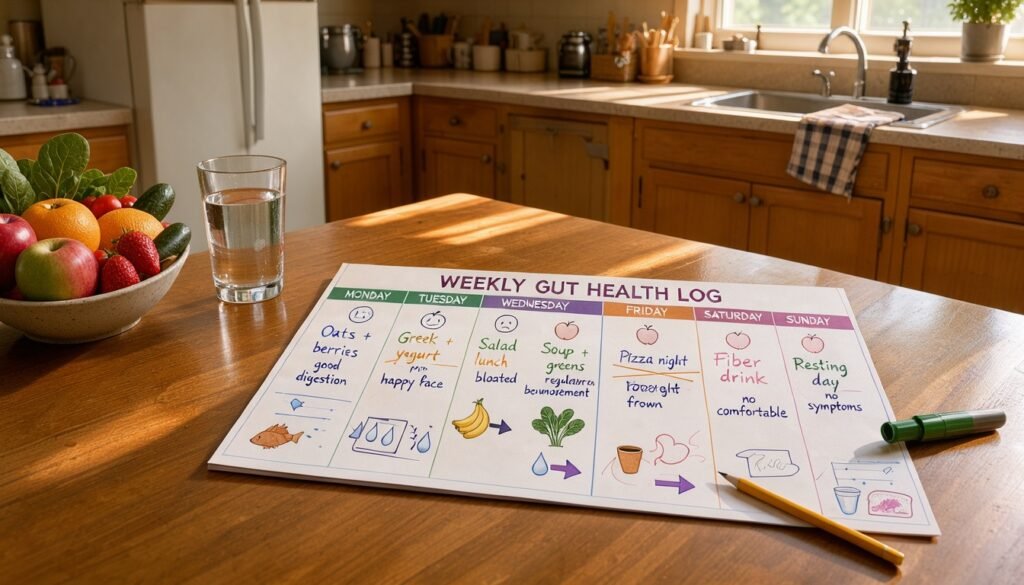
Start with a few repeatable fields: what you ate or drank, what you felt, and when each happened. Clear entries help you compare meals and symptoms without turning the diary into a second job.
A symptom diary can include food and drink, medication and dosage, stool consistency and frequency, pain, gas, exercise, emotional status, and stressors. The daily symptom diary fields can help you and a clinician explore possible relationships among these details.

| Log entry | Examples | Useful detail |
|---|---|---|
| Food and drink | Meals, water, whole grains, legumes, vegetables, fruits, nuts, seeds, yogurt, kefir, sauerkraut, kimchi, kombucha, tempeh, water kefir | Time, portion, and preparation |
| Bowel movements | Frequency and stool consistency | Date and time of each movement |
| Symptoms | Pain and gas | Onset time and severity |
| Medication | Medication name | Dosage and time taken |
Plant foods and fermented foods are neutral examples to record, not foods you must add or avoid. A short note can make otherwise similar entries easier to compare. For instance, you might distinguish a small serving from a large one, or note whether a meal was baked, fried, or eaten raw.
Keep the amount of detail manageable. A few words often give you enough context to understand an entry later, while long descriptions can be hard to sustain. If an item is not relevant to the question you are exploring, you can leave it out rather than tracking every habit by default.
Medication is worth recording alongside the date, even when it seems unrelated to digestion. Record medication and dosage beside the date, since timing can matter when reviewing a change.
Meal Timing and Symptom Onset
A meal at lunchtime and bloating that evening are two time-stamped observations, not yet a cause-and-effect finding. Separate times let you compare events without assuming the latest meal explains what followed.
Write down the meal time and the time a symptom begins as separate details. “Felt bad later” is hard to compare because it does not identify when the symptom started or what it felt like. A clearer note could say that bloating began at 7 p.m. after lunch at noon.
- Note the meal or drink and the time you had it.
- Record when a symptom begins and name its type.
- Add a brief note when another event or context may matter.
Use the same clock style each day, such as 12-hour times with a.m. and p.m. That small choice keeps morning and evening entries from becoming confusing. If you are unsure of the time, mark it as approximate rather than presenting a guess as exact.
Symptoms can appear well after a meal, and other events may occur in between. Separate entries let you see the order without forcing a conclusion about what caused what. You can also record a symptom that starts before eating, which may be useful when comparing different days.
Meal timing is only one part of the record. A change in routine or another event close to symptom onset may help explain why similar meals do not always lead to the same experience. Use the same time format each day so entries can be compared without guesswork.

How Do You Use the Bristol Stool Chart?
The Bristol Stool Chart gives seven shape-and-consistency categories that make stool descriptions more consistent. Use it to record what a bowel movement looked like, not to diagnose a digestive condition. Consistency matters because the same description makes entries easier to compare.
The chart groups types 1-2 as suggestive of constipation, types 3-4 as soft and well formed, and types 5-7 as suggestive of diarrhea or urgency. Choose the closest description and use it consistently.
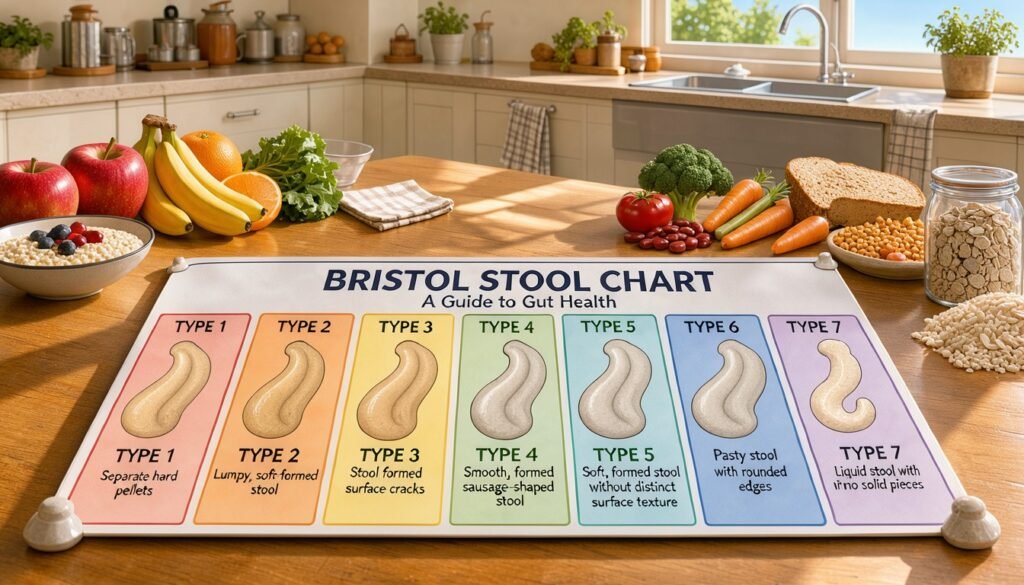
| Types | Description | Broad interpretation |
|---|---|---|
| 1-2 | Type 1: separate hard lumps. Type 2: hard and lumpy but sausage-shaped. | Suggestive of constipation |
| 3-4 | Type 3: sausage-shaped with surface cracks. Type 4: smooth, soft, and snakelike. | Soft and well formed |
| 5-7 | Type 5: soft blobs with clear-cut edges. Type 6: fluffy, mushy pieces with ragged edges. Type 7: watery stool with no solid pieces. | Suggestive of diarrhea or urgency |
Types 1 and 2: Hard or lumpy stool
Types 1 and 2 describe separate hard lumps or a hard, lumpy sausage shape. In the chart’s broad interpretation, these types suggest constipation. Recording the type gives you a consistent description without needing to decide what caused the stool’s texture.
Types 3 and 4: Formed stool
Type 3 is sausage-shaped with surface cracks; type 4 is smooth, soft, and snakelike. Both fall into the chart’s soft, well-formed group. These descriptions provide a shared shorthand when your own notes might otherwise use changing words.
Types 5, 6, and 7: Softer or watery stool
Type 5 consists of soft blobs with clear-cut edges. Type 6 is fluffy and mushy, with ragged edges; type 7 is watery with no solid pieces. These types broadly suggest diarrhea or urgency, but the chart remains a description tool, not a diagnosis.
Recording the type at the time can be more reliable than trying to remember it later. If a stool falls between descriptions, record the closest type and any relevant note rather than forcing certainty.
Lifestyle Factors That Shape the Picture
A difficult night or stressful day can be useful context beside a symptom entry, even when it cannot explain that symptom by itself. Context is not cause, so note these details as observations rather than conclusions.
In a study of more than 1,400 generally healthy adults, younger people, women, and people with a lower BMI tended to report less frequent bowel movements. Participants who reported fiber-rich diets, better hydration, and regular exercise tended to fall in the study’s group reporting 1-2 bowel movements per day. These are group patterns, not proof of an individual cause.
Stress, sleep, and emotional status
Stress, sleep, emotional status, and rest can help describe what surrounded a symptom. You might note that you slept poorly, had a demanding day, or felt unusually tense. Those notes do not show that stress or sleep caused a digestive change, but they give you more context when comparing entries.
Keep the description plain. “Awake for much of the night” is more useful than “terrible sleep,” because it says what happened without turning the record into a rating. The same goes for stress: a brief note about an event can be clearer than a score with no explanation.
Exercise, hydration, and diet
Exercise, hydration, and diet are also context variables. A walk, a change in water intake, or an unusual eating routine may help describe a day, but one entry does not establish an effect on digestion. The study’s findings describe generally healthy adults as a group, not a rule for every person.
Your habits can vary from one day to the next, so avoid reading one factor as a complete explanation. A detailed record can help you see whether a detail regularly appears alongside a symptom or whether it was only present once. Log the context in a neutral way, such as noting stress or sleep, rather than scoring the day as good or bad.

When Does a Food Pattern Look Consistent?
A food association becomes more interesting when the same symptom follows the same food on separate occasions. Repetition is useful, but it still does not establish that the food caused the symptom.
One prospective observational study of 51 adults with IBS found different associations in two subgroups. High-FODMAP meals were associated with abdominal bloating among participants with IBS-D, while fiber intake was correlated with abdominal fullness and bloating among participants with IBS-C.

| Study group or measure | Logged factor | Observed association |
|---|---|---|
| PROMIS measures | Food and Symptom Times diary | Moderate correlations with comparable symptom measures |
| Gastrointestinal Symptom Rating Scale questions | Food and Symptom Times diary | Moderate correlations with comparable symptom measures |
| Participants with IBS-D | High-FODMAP meals | Associated with abdominal bloating |
| Participants with IBS-C | Fiber intake | Correlated with abdominal fullness and bloating |
These findings describe adults with IBS in a specific study, not a universal food rule. A food that appears alongside a symptom for one subgroup may not affect someone else in the same way. An association in a study also does not establish that a food was the only factor involved.
Look for repetition across separate occasions
Compare occasions when the same food appears, and note whether the same symptom follows. Look for similar timing and symptom descriptions rather than treating two vaguely similar experiences as a firm pattern. Entries from days without the symptom can also add perspective.
Keep other logged factors in view
Stress, sleep, medication, and timing can change alongside food. A suspected pattern is easier to interpret when you can see those details too. If the symptom occurs after a food only on days with another notable change, that context is part of the observation.
A varied diet may include many foods, and a log is a way to describe your own experience, not rank foods by value. Keep a suspected food in the log while you gather context instead of treating one episode as proof.
Food Logs and Suspected Sensitivities
A food log can help you describe a suspected reaction clearly, but the pattern alone cannot identify its medical cause. A symptom record is not a clinical test. It can organize food, timing, and symptoms for a conversation with a qualified healthcare professional.
A reaction might involve lactose intolerance, cow’s milk allergy, another condition, or coincidence. Those possibilities are not interchangeable. Lactose intolerance involves difficulty digesting lactose, while a cow’s milk allergy is an immune response to milk proteins.
The review of food intolerance explains that self-reported reactions do not always establish an intolerance. Some conditions have validated diagnostic tests, including lactose intolerance, while symptoms alone cannot confirm a cause.

That distinction matters because a person can experience symptoms without knowing which explanation fits. A repeated pattern can help you explain what happens and when, but it cannot tell you whether the cause is an intolerance, allergy, or something else.
A symptom log also cannot determine whether changes in the gut microbiome or microbes explain an individual’s symptoms. Gut microbiome balance and diversity are broad topics, but a personal food-and-symptom pattern does not prove a specific microbiome change. Avoid treating a log as evidence for a mechanism it cannot measure.
Do not make major dietary changes based only on a hunch in your entries. Broad food restrictions can remove foods without clarifying the cause of symptoms. Bring a suspected sensitivity pattern to a qualified healthcare professional before making major dietary changes.
Why Logs Cannot Diagnose a Condition
A symptom-and-food log can document a pattern, while diagnosis requires clinical evaluation. Recording is not diagnosing: a log captures your reported symptoms, their timing, and relevant context.
A repeated association can give you a focused question for a healthcare professional. It cannot establish that a particular food, habit, or body process caused the symptom. A pattern in a diary is not a diagnosis or proof of a specific mechanism.
What a log can establish
Your record can show what you noticed, how often you recorded it, and what else was happening around that time. It can also show where the record is uncertain or incomplete. Those details make an observation clearer, but they remain descriptions of your experience.
For example, several entries may show that you reported abdominal discomfort after similar meals. That sequence is a useful observation to review, not a finding that the meals caused the discomfort. Other information may change how a clinician interprets the same sequence.
What clinical evaluation adds
Diagnosing IBS or another condition requires clinical evaluation. A healthcare professional may consider your symptom history and other information to assess what could explain your concerns. A diary can support that conversation, but it cannot replace the evaluation.
This boundary helps keep self-observation useful without asking it to do more than it can. You can bring a repeated pattern forward as a question and let a clinician assess it with the broader history. Use the record to support a clinical conversation, not to name a condition on your own.

Bowel Frequency Categories in Context
Frequency categories can help describe a pattern, but they are not a stand-alone assessment of health. Study labels group reported bowel movement frequency; they do not set a personal goal for every adult.
In a study of more than 1,400 generally healthy adults, researchers grouped reported frequency into constipation, low-normal, high-normal, or diarrhea. The numerical ranges below are categories used in that study.
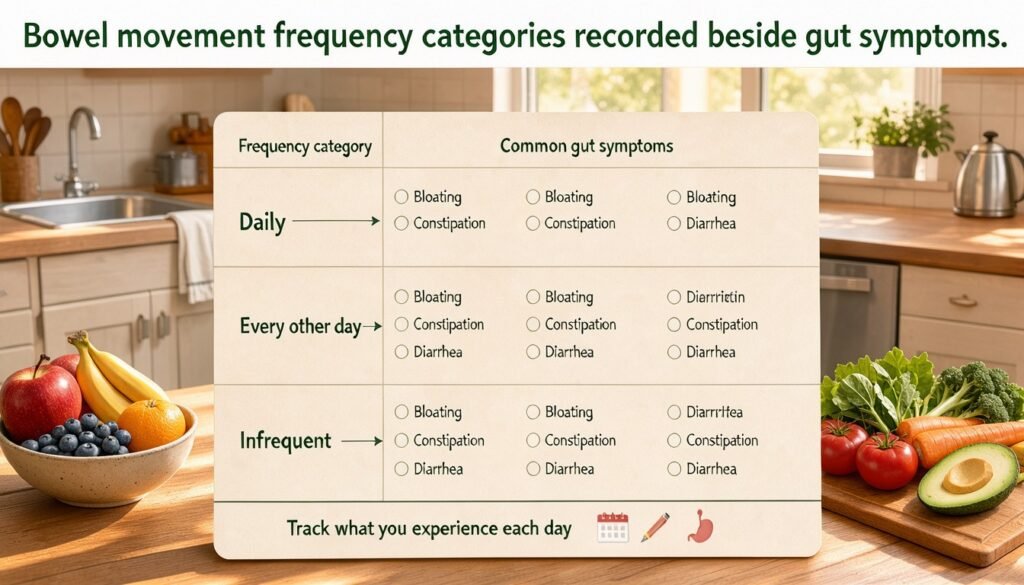
| Study category | Reported frequency | How to read it |
|---|---|---|
| Constipation | 1 or 2 per week | Study category for reported frequency |
| Low-normal | 3-6 per week | Study category for reported frequency |
| High-normal | 1-3 per day | Study category for reported frequency |
| Diarrhea | Diarrhea | Study category without a numerical grouping stated here |
Frequency categories used in a study of generally healthy adults
The labels summarize how researchers grouped participants by reported frequency. In that study, the labels included constipation at 1 or 2 bowel movements per week, low-normal at 3-6 per week, and high-normal at 1-3 per day. Diarrhea was another category.
The study categories describe a group, not the full range of what any one person experiences. Frequency is only one detail. Stool consistency and symptoms help explain whether a number reflects a familiar pattern or a change worth discussing.
Why a category is not a personal target
Your usual pattern matters when interpreting a change. Someone whose frequency differs from a study category cannot use that difference alone to assess health. Likewise, a number that fits a category does not explain discomfort or other changes by itself.
Read frequency alongside consistency and how you feel. That combination gives a more complete description than a count alone, without turning a study label into a score. Record frequency alongside consistency and symptoms so a number is not read in isolation.
Choosing a Tracking Format
The best format is the one you can use consistently and that captures the details you want to review. Simple is practical: a free-form notebook can work as well as a structured digital diary when you keep the information readable.
A paper journal gives you room to write in your own way. A spreadsheet organizes entries into columns, making dates or repeated categories easier to scan. A mobile app may offer structured fields that guide entries, though its layout may limit how you describe an unusual day.
No format makes a diagnosis. Apps can collect diary entries, but a numerical gut health score or gut health score summary is not a medical assessment. Treat any score as a summary of the information it uses, not a diagnosis of your gut or overall health.
Paper journals and spreadsheets
A paper journal suits you if you prefer handwriting and flexible notes. You can keep a small notebook near a place where you will remember to write. A spreadsheet suits you if you want entries arranged in columns and can manage typing them in regularly.
Neither format needs elaborate design. A spreadsheet with clear headings can be easier to scan than a complex system you rarely update. A journal can be easier to use when you want to capture a detail that does not fit a fixed column.
Apps and passive tracking devices
An app may be useful when structured prompts make it easier to keep a routine. Check that its fields suit the kind of record you want, rather than choosing it for a polished dashboard or a numerical health score.
Passive tracking devices can collect selected signals automatically when available. They do not necessarily record food, symptoms, or the context of a meal. If a device does not capture those details, you still need a diary to record them.
The tool should reduce effort, not create a new task that distracts from useful observations. Choose the simplest format that lets you record both symptoms and relevant context.
Preparing a Useful Clinician Summary
A clinician can review a clearer history when the record separates what happened from what you think may explain it. A concise summary can make an appointment easier to use, especially when the original diary contains many entries.
Keep the summary factual and focused on details that help explain your concern. You can include your interpretation, but label it as a possibility rather than a recorded fact. Separate observations from explanations.
- Dates covered by the record.
- Main symptoms and how often they occurred.
- Any repeated food or lifestyle association.
- Medication changes during the period covered.
- Questions you want to ask the clinician.
For example, “bloating followed dinner on three recorded evenings” describes an observation. “Dinner caused bloating” states a conclusion that the record alone cannot establish. Keeping that difference clear helps a clinician assess what the entries show.
Bring the original log if the summary is brief. The full record may preserve timing or context that did not fit into a few lines. You do not need to turn every entry into a chart; a useful summary gives the clinician a clear starting point.
Write your questions before the appointment, so you can raise them even if the discussion moves quickly. A question can be as direct as asking which repeated observations deserve further evaluation. Bring the log or a concise summary and ask which patterns are worth evaluating.
When Digestive Symptoms Need Medical Attention
Some symptoms call for medical evaluation rather than more time spent trying to interpret a log. Persistent digestive symptoms lasting longer than 2 weeks warrant medical attention, particularly when accompanied by abdominal pain, bloody stools, or unintentional weight loss.
Blood in stool, black and tarry stools, unexplained weight loss, and anemia also warrant medical evaluation because they can indicate a problem other than IBS. Do not treat these signs as a pattern to manage through tracking alone.
A healthcare professional can assess these symptoms in the context of your health and history. The warning signs that warrant medical evaluation include changes that should not be explained away by a food pattern or a personal baseline.
Symptoms can have different causes, and a log cannot determine which one applies. If you notice one of these concerns, focus on getting appropriate medical attention rather than waiting for more entries to make the pattern seem clearer.
This guidance is not a reason to assume the worst. It is a practical boundary: persistent symptoms and the listed warning signs deserve evaluation. Contact a healthcare professional when these symptoms occur.
Tracking Mistakes That Can Mislead
A detailed log can still mislead if several changes happen at once or one memorable episode gets treated as a pattern. Keep comparisons fair by noting what changed and avoiding conclusions based on a single entry.
Changing several foods or habits at once makes it difficult to tell which change, if any, lines up with a symptom. A sudden shift in meals, exercise, and sleep can leave you with several possible explanations and little clarity about their timing.
Changing too many things at once
When you alter multiple parts of your routine together, the diary may show that symptoms changed without showing which detail mattered. Record the changes plainly. That way, the record reflects the real context rather than implying that one food or habit acted alone.
Treating a single entry as a cause
One meal followed by discomfort is a real observation, but it does not prove a trigger. A memorable episode can stand out more than ordinary days, so compare it with other entries before giving it special meaning.
Other practical pitfalls can make comparisons less clear:
- Leaving out medication changes.
- Recording vague timing instead of an approximate time.
- Switching stool descriptions from day to day.
If you miss an entry, mark it as missing. Rebuilding details from memory can make a guess look like a precise record, especially when several days have passed. A clearly noted gap is more honest and useful than a confident reconstruction.
Consistent notes do not require perfect recall. They require you to show what you know and where your memory is uncertain. Mark uncertain or missing details clearly instead of filling gaps with guesses.
A Simple Routine You Can Sustain
A small, repeatable log is easier to keep than a complicated record of every part of the day. Start small with a routine that answers one real question, rather than trying to track everything that might affect gut health.
Choose a format you can return to without much effort. A paper journal, spreadsheet, or app can each work, as long as it helps you capture details in a way you can review. You do not need a gut health score to make useful observations.
- Choose a paper journal, spreadsheet, or app.
- Select a small set of fields that match your concern.
- Review entries at a regular time and note questions for a clinician.
Keep the first version modest. If your concern is a change in bowel habits, choose fields that help describe that change. If a detail does not answer a question you have, you can leave it out until there is a reason to add it.
A tracking routine should help you notice useful details, not turn every habit into a score.
During a regular review, look for entries that raise a clear question. You might notice that a symptom appears at similar times, or that there is not enough detail to compare several days. Either result helps you decide what to pay attention to next.
A numerical health score cannot replace those observations or clinical judgment. Better gut health is not a score you can calculate from a few entries. Use the record to understand your own notes, and add fields only when they serve a real purpose.
Start with a few fields today and use the next review to decide whether anything else needs tracking.
Conclusion
A log turns scattered memories into observations you can review. Repeated entries can make possible relationships between food and symptoms easier to notice, but a log cannot diagnose a condition.
Keep the next step simple: begin a record of meals, symptoms, and timing. If useful observations raise questions about your health, bring them to a healthcare professional for discussion.
Choose a few fields and make your first entry today.









Discussion about this post