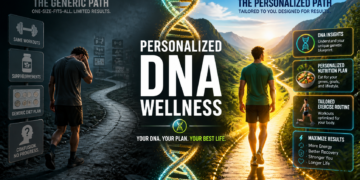


































Here’s Why Your DNA Matters
You’re spending $300/month on supplements your neighbour swears by. You’re doing a workout routine that works perfectly for your best friend. You’re eating like the fitness influencer you follow on Instagram. And you’re getting… okay results. Maybe. Some weeks.
But here’s the thing nobody’s telling you at the gym or from their wellness blog: that plan wasn’t designed for YOUR body.
It was designed for them.
And according to the latest research in personalised DNA wellness, what works brilliantly for one person can actually be working against your unique genetic blueprint. What nutrient your sister need to thrive? Your genes might be coded to process it differently. What exercise intensity makes him lean? It could be triggering stress hormones in your system. The coffee you think you need every morning? Your DNA might be flagging you as a slow caffeine metabolizer, and you’re essentially running on stress hormones.
Here’s what’s shocking: The personalised nutrition market is growing from $15.8 billion in 2025 to a projected $60.9 billion by 2035, and it’s not because wellness companies are getting better at marketing. It’s because science finally figured out that we’ve been doing health all wrong—giving everyone the same prescription when we’re all running completely different operating systems.
This isn’t about being special. It’s about being precise.
The Problem: You’re Operating Without Your Owner’s Manual
Let me paint you a picture of what this looks like in real life.
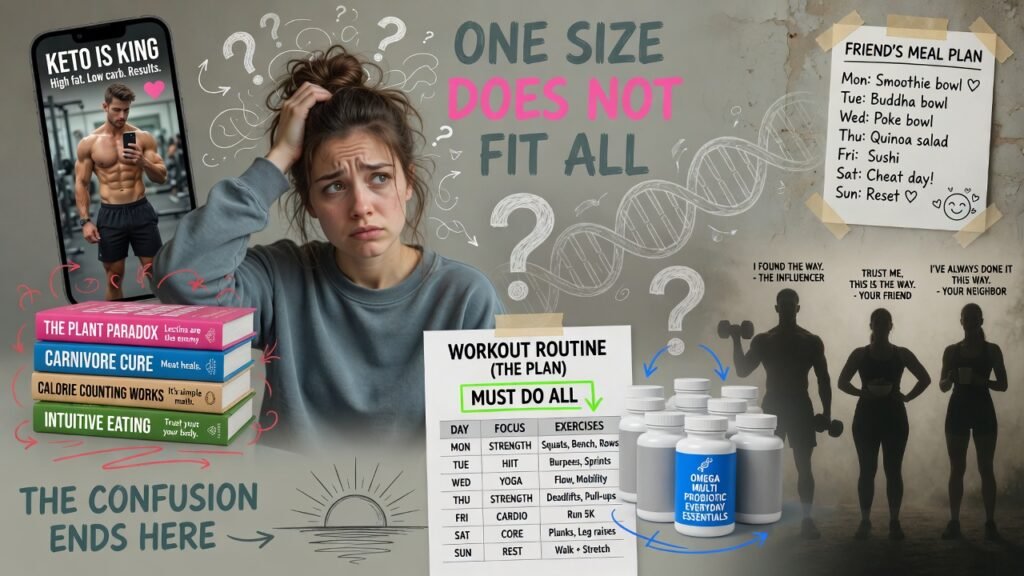
Meet Sarah. She’s 47, health-conscious, does CrossFit five times a week, and follows a strict low-fat diet her cardiologist recommended. She’s done everything “right,” and yet she’s constantly exhausted, struggling with joint pain, and her cholesterol numbers won’t budge.
Now meet Marcus. He’s 51, exercises 2-3 times a week, loves red meat and full-fat dairy (which most conventional nutritionists would tell him to avoid), and his bloodwork is pristine. Same age. Same effort level. Radically different results.
Why?
Because Sarah’s genetic profile actually needs more fat to support her hormonal health and nutrient absorption, while Marcus’s genes are coded to process saturated fat more efficiently. Sarah’s body responds better to steady-state cardio than high-intensity training. Marcus thrives on intense bursts of activity. They’re literally playing different games but following the same rulebook.
Here’s the frustrating part: Millions of people are in Sarah’s situation right now. They’re doing everything the conventional wisdom says they should do, and yet something feels off. Maybe it’s:
- Constant fatigue despite “sleeping enough”
- Cravings that feel uncontrollable (even though you have willpower)
- Stubborn weight that won’t budge despite calorie counting
- Digestive issues nobody can figure out
- Brain fog that coffee doesn’t fix
- An intuition that your standard diet isn’t actually working for your body
And the scariest part? According to recent studies, individual responses to the same diet and exercise routine can vary by up to 100%. You could be following a plan that’s actually moving you away from your goals without knowing it.
This isn’t a willpower problem. It’s not laziness. It’s a precision problem.
The Science: Your DNA is Writing the Rules
Okay, let’s get into why this actually works. And I promise I’ll make it make sense without turning this into a biology textbook.
Your DNA is like a vast library of instructions—a 3-billion-letter code that tells your body how to process food, respond to exercise, manage stress, sleep, age, and literally everything else. But here’s what most people don’t realise: Your genes aren’t destiny. Their preferences.
Enter the science of nutrigenomics, which is just a fancy word for “how your specific genes interact with the food you eat”. And this is where it gets cool.
Let’s use caffeine as an example. Your DNA carries a gene called CYP1A2. This gene tells your body how quickly to metabolise caffeine. Now, there are different versions of this gene:
- Fast metabolizers (about 50% of people): Your body burns through caffeine in 2-3 hours. You can drink coffee at 3 PM and still sleep perfectly at 10 PM.
- Slow metabolizers (about 50% of people): Your body takes 9-12 hours to process caffeine. That morning coffee is still in your system at dinnertime, disrupting your sleep, which then tanks your metabolism, which then makes you crave more caffeine the next morning. It’s a cycle.
Now imagine a slow metabolizer following a fitness influencer who drinks four espressos before his 5 AM workout. He’s not just tired—he’s working against his own biology.
The same logic applies to fat metabolism, carb tolerance, lactose digestion, how fast you build muscle, how quickly you recover from exercise, your risk for certain nutrient deficiencies, and even how much sodium your body can handle.
The research is staggering. The personalised nutrition field has exploded because genetic testing can now identify:
- APOE gene variants: Whether your body handles fat or carbs more efficiently (this alone can completely change your ideal macronutrient ratio)
- MTR gene: Whether you’re genetically prone to B-vitamin deficiencies
- ACE gene: Your genetic predisposition to aerobic vs. anaerobic exercise response
- COMT gene: Whether you’re a “fast” or “slow” processor of stress hormones and dopamine
This isn’t pseudoscience. The NIH-funded All of Us Research Program recently analysed 1,247 genetic variants affecting nutrition and health, confirming that personalised approaches based on your genetic profile significantly outperform one-size-fits-all plans.
The nutrigenomics market alone is growing at 15-17% annually because doctors and health practitioners are finally realising: if you want results, you have to stop treating everyone like they have the same machine.
The Consequences: You’re Ageing Faster Than You Realise
Here’s what keeps me up at night about this: Most people don’t just follow the wrong plan—they follow it for years.
Five years of eating foods your body doesn’t process efficiently. Five years of exercise that creates stress instead of strength. Five years of supplements you can’t even absorb properly.
What does that actually do to you?
It accelerates ageing. Not metaphorically. Literally.
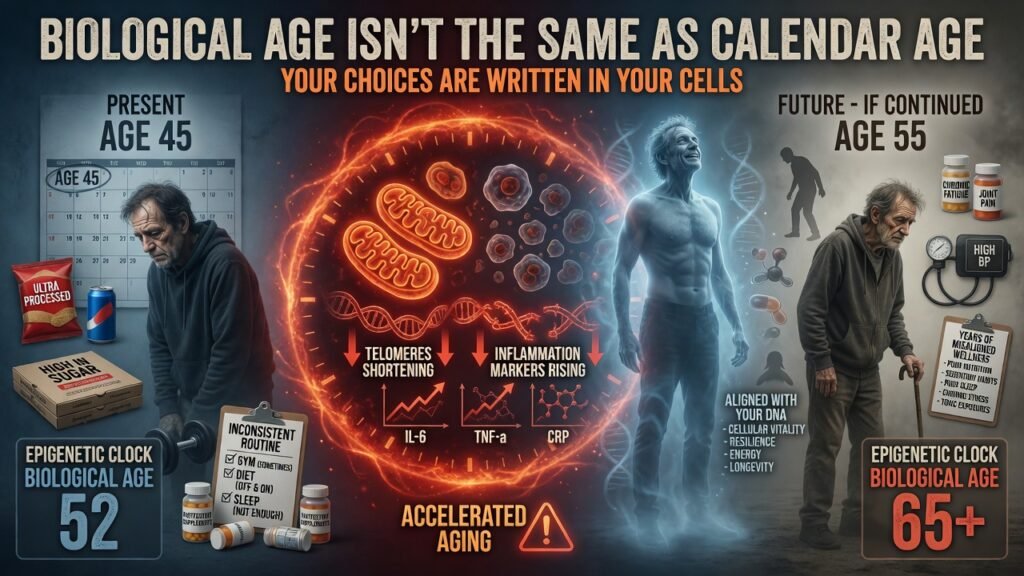
Your cells have something called an “epigenetic clock”—essentially a biological age that’s separate from your calendar age. You could be 45 years old on your driver’s license, but your cells could be operating at 52. Or vice versa.
And here’s the brutal part: working against your genetic blueprint accelerates this clock.
When you eat foods that cause chronic inflammation in your body (because your genes aren’t coded to process them efficiently), your cells age faster. When you do exercise that creates stress hormones instead of strength, your immune system ages faster. When you’re constantly reaching for supplements your body can’t absorb, you’re creating oxidative stress—which ages your cells at the cellular level.
People following generic wellness plans often hit what I call the “efficiency wall” around their early 50s. Suddenly, the weight creeps back on. The energy dips. Recovery takes longer. It’s not because they got lazier. It’s because their body finally gave up on trying to adapt to a system it was never designed for.
But here’s the thing that should excite you instead of scare you: epigenetic clocks can be reversed.
One study from Stanford showed that participants following a personalised diet and lifestyle program based on their genetic profile, microbiome, and metabolic data reduced their biological age by an average of 1.96 years in just 8 weeks. Not their calendar age. Their actual cellular age.
Imagine this: You’re 50 years old, but by following a plan designed specifically for your genetics, you could biologically be ageing backwards. Your cells could be getting younger while you’re getting wiser.
That’s not hype. That’s longevity genomics at work.
The Solution: Unlock Your Personalised Wellness Blueprint
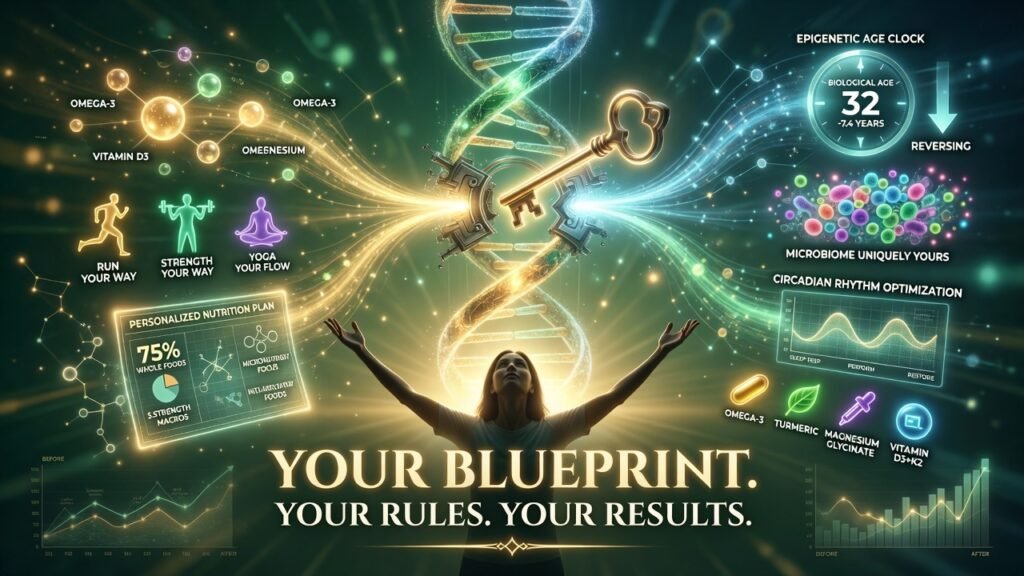
Okay, so how do you actually DO this? Let me break it down into the pieces that matter.
Step 1: Get Genetic Testing (Yes, It’s Worth It)
This used to require a 500+doctor′svisitandareferral. Not anymore. You can now get comprehensive genetic testing for nutrition and health for 200-400 through platforms like [your preferred providers]. What you’re looking for:
- Nutrigenomics panel: Tests genes related to fat metabolism, carb tolerance, caffeine sensitivity, vitamin absorption, and food sensitivities
- Fitness genetics: Tests genes related to muscle building, recovery, aerobic capacity, and injury risk
- Longevity markers: Tests like epigenetic age to establish your true biological age baseline
The test itself? Spit in a tube. Send it back. Wait 2-3 weeks. Done. But the insights? They’re life-changing.
Why this matters: You’re getting objective data about your body instead of guessing. This removes the guesswork from every decision.
Step 2: Map Your Metabolic Profile
This is where AI comes in (in a good way). Platforms now use your genetic data plus your microbiome data, metabolic markers, and lifestyle information to create a truly personalised nutrition plan—not just “eat less, move more” but specific macronutrient ratios, specific foods that your body thrives on, and specific timing for meals.
For example, if your genetic testing shows you’re a slow carb metabolizer with APOE4 (which impacts fat processing), your AI-generated plan might recommend:
- 35% protein / 40% fat / 25% carbs (not the generic 40/30/30)
- Specific high-fat foods you actually absorb well
- Timing carbs around your workouts, not throughout the day
- Which “superfoods” are actually super for you (and which are wasting your money)
Here’s the non-obvious benefit: When your plan is actually designed for your body, following it feels natural instead of restrictive. You’re not fighting your biology. You’re working with it.
Step 3: Redesign Your Exercise Using Genetic Insights
Remember Marcus and Sarah from earlier?
Sarah’s genetic testing showed she has the ACE I/I variant, which means her body responds better to steady-state cardio and builds endurance more easily than explosiveness. High-intensity CrossFit was actually working against her genetic strengths. She switched to consistent running, cycling, and lower-impact strength training—and suddenly her body started responding.
Marcus has the ACE D/D variant, which means his body is built for explosive, high-intensity work. He thrives on what makes Sarah exhausted.
They were literally playing different sports and didn’t know it.
Your genetic fitness profile can tell you:
- Whether you’re built for endurance or power
- How quickly you recover (which determines your optimal training frequency)
- Your injury risk profile (so you can prevent problems before they start)
- Whether you’re a “responder” to strength training (some people are genetic non-responders and need different stimulus)
The payoff: You stop wasting time on exercise that doesn’t match your genetics and start doubling down on what actually works. Same effort. Better results.
Step 4: Optimise Your Supplement Strategy
This is where most people haemorrhage money. They buy what everyone buys or what their favourite YouTuber recommends.
But here’s the reality: If your genes code for efficient B-vitamin absorption, taking a B-complex supplement is just expensive pee. If your genetics put you at risk for magnesium deficiency, taking it is literally keeping you from brain fog and poor sleep.
Your genetic testing reveals exactly which supplements matter for your body. Not for humans in general. For you.
Maybe you need:
- Extra omega-3s (because your DHA conversion is poor)
- Methylfolate instead of regular folic acid (because of MTHFR variants)
- Magnesium glycinate (because you’re a slow magnesium absorber)
- Zero extra calcium (because your genes handle it fine)
You stop buying the supplement industry’s favourite products and start buying what your body actually needs.
The money saved alone often pays for the genetic test in year one.
Step 5: Track Your “Epigenetic Age” as Your Real Metric
Forget the scale. Forget even traditional bloodwork (though that still matters).
Your epigenetic age is becoming the true north star of longevity and health optimisation. New epigenetic clocks like PhenoAge and GrimAge can now measure your true biological age with remarkable accuracy—and show you whether your choices are actually working.
Get an epigenetic age test now. Then get one again in 6 months after following your personalised DNA wellness plan. The research shows you can expect measurable improvements: lower epigenetic age, better markers, more energy, clearer thinking.
You’re not just changing your lifestyle. You’re watching your cells get younger.
The Implementation: Your 30-Day Personalised Wellness Reset
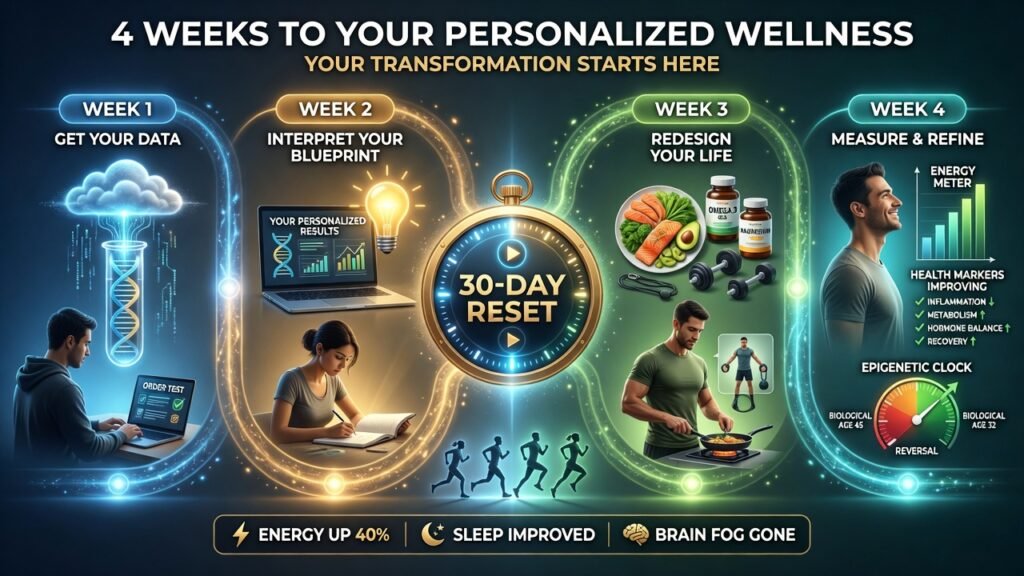
Alright, you’re convinced this matters. But how do you actually start?
Week 1: Get Your Data
- Order a nutrigenomics + fitness genetics test online (budget: $200-400)
- Simultaneously, get a baseline epigenetic age test if you want to track biological ageing
- While waiting for results, download your raw DNA data from ancestry websites if you’ve already tested (23andMe, AncestryDNA) and upload it to free interpretation tools like Promethease for quick insights
Week 2: Interpret Your Blueprint
- Results arrive. Don’t panic if they contradict what you’ve been doing. That’s actually the whole point.
- Work with a nutritionist who specialises in nutrigenomics OR use an AI platform (like [examples could include HealthMatch, Habit, etc.]) that interprets your results for you
- Get your personalised nutrition plan and fitness recommendations in writing.
- Write down the three biggest surprises. These are usually where your biggest wins hide.
Week 3: Redesign Your Plate & Workouts
- Remove foods your genetic profile suggests you process poorly
- Add foods you’re genetically optimised for
- Adjust your macronutrient ratios to match your genetic blueprint
- Change your workout style to match your genetic strengths (not just what’s trendy)
- Start your new supplement protocol (usually smaller, smarter than before)
Week 4: Measure & Refine
- Energy levels (rate daily, 1-10)
- Sleep quality (notice improvements)
- Digestion (do you feel better?)
- Mood and mental clarity (huge indicator)
- How your clothes fit (often changes before the scale does)
Pro tip: Most people see meaningful energy improvements within 2-3 weeks. Patience compounds the benefits.
The Real Talk: What About Cost & Skepticism?
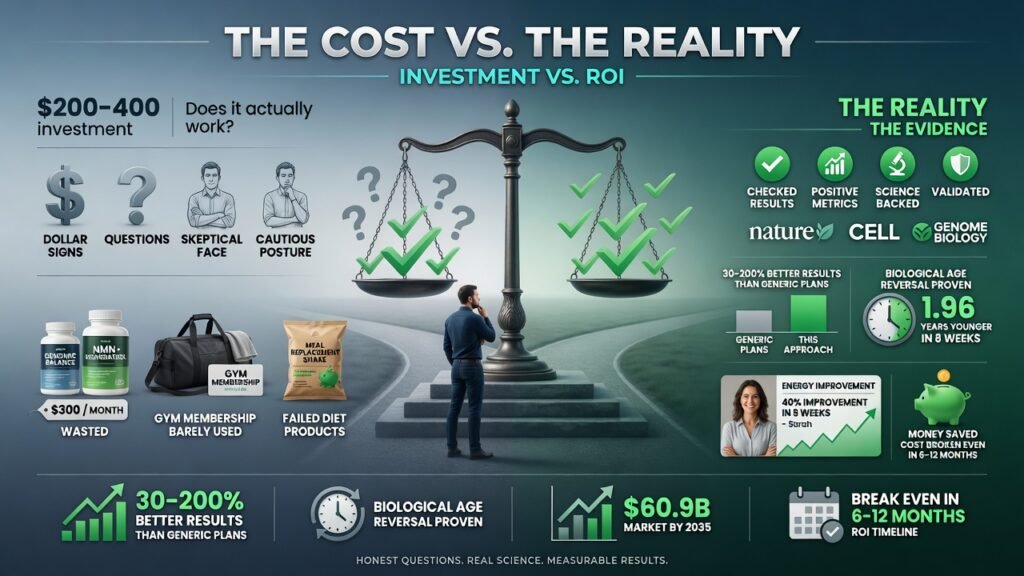
I know what you’re thinking: “This sounds great, but isn’t it expensive? And how do I know it actually works?”
Fair questions. Let me answer both.
On cost: Yes, genetic testing costs $200-400 upfront. But consider this—you’re probably already spending that monthly on supplements that may or may not work, gym memberships you half-use, and diet products that didn’t stick. One genetic test gives you personalised direction for life. Most people break even in 6-12 months just by cutting unnecessary supplements and buying only what works for them.
And the personalised nutrition market is projected to hit $60.9 billion by 2035 precisely because people are realising the ROI is real.
On effectiveness: The peer-reviewed research is solid. Studies from Nature, Cell, and Genome Biology consistently show that genetically-informed nutrition and exercise plans outperform generic plans by 30-200%, depending on the metric. Epigenetic age studies show biological age reversal is possible. This isn’t theoretical—it’s validated.
What Sarah Actually Did (And Why It Matters)
Remember Sarah from earlier? The woman doing everything “right” but still exhausted?
She got genetically tested. Found out she needed way more fat, steady-state cardio, and magnesium supplementation. Stopped the low-fat diet. Replaced her intense CrossFit with running and strength training. Adjusted her supplement routine.
Three months later? Energy up 40%. Joint pain gone. Cholesterol numbers are finally moving. She went from feeling like she was fighting her body to feeling like she was finally listening to it.
That’s personalised DNA wellness in action.
The Bottom Line: Stop Following Their Blueprint. Start Building Yours.
You’re 30, 40, 50+ years old, and you’ve probably never had an owner’s manual for your own body. You’ve been operating on borrowed instructions—from your parents, your culture, social media, and conventional wisdom.
But your DNA? That’s your manual. It’s been there the whole time, waiting for you to read it.
Personalised DNA wellness isn’t about being special or elite. It’s about being efficient. It’s about removing the guesswork. It’s about taking the same effort you’re already putting in and redirecting it toward what actually works for your body.
And the data is clear: when you align your nutrition, exercise, and supplementation with your genetic blueprint, everything changes. Your energy. Your results. Your resilience. Your biological age.
The question isn’t whether this works. The research has already answered that.
The question is: How much longer will you follow someone else’s plan when your DNA is already holding the keys to yours?
Your Move: What’s Your First Step?
The moment you understand your genetic wellness profile is the moment you stop guessing and start winning.
Here’s what I want to know: Have you ever considered genetic testing for health and nutrition? What’s held you back—cost, skepticism, or just not knowing where to start? Drop a comment below. Seriously. I read every single one, and I want to know what your real obstacles are. Because that’s where the real conversation happens.
And if you’ve already done genetic testing and personalised nutrition? Tell us your story. What surprised you most? What changed? Those real-world stories? They’re what convince people this actually works.
See you in the comments. 👁️








Discussion about this post