






























• Latest
Mental fitness

Mental Fitness: Small Habits That Support Emotional Well-Being

November 28, 2026
stress recovery

Stress Recovery: Small Ways to Reset During Overloaded Weeks

November 28, 2026
gut health tracking

Gut Health Tracking: What Symptom and Food Logs Can Tell You

November 24, 2026
Neurowellness & Mental Fitness

Neurowellness & Mental Fitness: Train Focus and Build Resilience

November 28, 2026
protein at meals

Protein at Meals: Practical Ways to Build Satisfying Meals

November 21, 2026
GLP-1 nutrition

GLP-1 Medications and Everyday Nutrition: Questions to Discuss With Your Clinician

November 19, 2026
women’s healthspan

Women’s Healthspan: What It Means and What It Doesn’t Promise

November 18, 2026
menopause symptoms

Menopause Symptoms: Prepare for a More Useful Appointment

November 17, 2026
midlife strength training

Midlife Strength Training: A Beginner’s Guide to Getting Stronger Safely

November 28, 2026
sleep regularity

Sleep Regularity: Why a Consistent Wake Time May Matter More Than a Perfect Bedtime

November 28, 2026
Heart attack in young adults

Heart Attack in Young Adults: Reproductive History and Risk

November 14, 2026
perimenopause sleep

Perimenopause Sleep: How to Sleep Through the Night

November 12, 2026
insulin resistance symptoms

Insulin Resistance Symptoms: Why Overworked Workers Can’t Lose Belly Fat?

August 4, 2026
Saturday, November 28, 2026
Subscribe to get Updates
  • Login
Wellness and Us Magazine
50 Wellness Resources
  • Home
  • Health
    • All
    • Blog
    • Disease
    • Eyes Health and Vision
    • Fitness
    • Health
    • History
    • Kids Health
    • Lifestyle
    • Longevity
    • Medical Innovations
    • Medications
    • Mental Health
    • News
    • Nutrition
    • Oral Health
    • Research
    • Weight Loss
    • Wellness
    • Women Health
    Mental fitness

    Mental Fitness: Small Habits That Support Emotional Well-Being

    stress recovery

    Stress Recovery: Small Ways to Reset During Overloaded Weeks

    gut health tracking

    Gut Health Tracking: What Symptom and Food Logs Can Tell You

    Neurowellness & Mental Fitness

    Neurowellness & Mental Fitness: Train Focus and Build Resilience

    protein at meals

    Protein at Meals: Practical Ways to Build Satisfying Meals

    GLP-1 nutrition

    GLP-1 Medications and Everyday Nutrition: Questions to Discuss With Your Clinician

    women’s healthspan

    Women’s Healthspan: What It Means and What It Doesn’t Promise

  • Weight Loss
    protein at meals

    Protein at Meals: Practical Ways to Build Satisfying Meals

    GLP-1 nutrition

    GLP-1 Medications and Everyday Nutrition: Questions to Discuss With Your Clinician

    insulin resistance symptoms

    Insulin Resistance Symptoms: Why Overworked Workers Can’t Lose Belly Fat?

    Metabolic Health

    Metabolic Health: Master Blood Sugar & Insulin Sensitivity Naturally

    The Truth About Popular Diets: Keto vs. Intermittent Fasting

    The Truth About Popular Diets: Keto vs. Intermittent Fasting

    10 Surprising Benefits of Drinking Water First Thing in the Morning

    10 Surprising Benefits of Drinking Water First Thing in the Morning

    How to Lose Belly Fat Without Exercise: Simple Science-based Tips

    How to Lose Belly Fat Without Exercise: Simple Science-based Tips

  • Our Channel
  • Disease
    insulin resistance symptoms

    Insulin Resistance Symptoms: Why Overworked Workers Can’t Lose Belly Fat?

    Breast Thermography: Technology, Benefits, and Cancer Signs

    Breast Thermography: Technology, Benefits, and Cancer Signs

    selective focus of senior woman holding digital tablet with heartbeat rate on screen

    Exploring the Efficacy of Digital Health Interventions for Heart Health

    Legs injury, swimming and sports person massage calf problem from exercise, training or workout cri

    What Your Legs Could Be Telling You About Your Heart Health

    Uncovering the Causes of Psoriatic Arthritis: Identifying Triggers and Risk Contributors

    Uncovering the Causes of Psoriatic Arthritis: Identifying Triggers and Risk Contributors

    What is Salicylic acid and why should I use it on my skin?

    What is Salicylic acid and why should I use it on my skin?

    Roasted coffee beans and ground coffee in filter holder

    Coffee and Cancer: Separating Fact from Fiction

  • Fitness
    The Paleo Lifestyle: How to Get Fit Naturally and Reclaim Your Energy in 2026

    The Paleo Lifestyle: How to Get Fit Naturally and Reclaim Your Energy in 2026

    How to Lose Belly Fat Without Exercise: Simple Science-based Tips

    How to Lose Belly Fat Without Exercise: Simple Science-based Tips

    Unrecognizable female with manicure checking smartwatch on hand while sitting on yoga mat

    Fitness and Fun: Mastering Your Vitals for a Healthier You

    Thigh and butt exercises

    Bootylicious Gains: Unveiling the Best Exercises for a Toned Glutes

    Sportsman working out with kettlebell in gym

    A Trainer Answers: What’s the Best Workout For Losing Weight?

    Runners training in New York

    Mastering the Half Marathon: How This Simple Cardio Swap Boosts Your Training

    Man with weight training equipment exercising in sport gym club

    Loose Weight Fast: Ditch the Weight, Embrace Your Best Self with Expert Tips

  • Nutrition
    protein at meals

    Protein at Meals: Practical Ways to Build Satisfying Meals

    GLP-1 nutrition

    GLP-1 Medications and Everyday Nutrition: Questions to Discuss With Your Clinician

    insulin resistance symptoms

    Insulin Resistance Symptoms: Why Overworked Workers Can’t Lose Belly Fat?

    Metabolic Health

    Metabolic Health: Master Blood Sugar & Insulin Sensitivity Naturally

    Nutrigenomics

    Eat for Your Genes: The Nutrigenomics Revolution in Personalised Nutrition

    7 Signs Your Body Is Secretly Deficient in Magnesium (And What to Do About It)

    7 Signs Your Body Is Secretly Deficient in Magnesium (And What to Do About It)

    10 Most Dangerous Foods: A Scientific Perspective

    10 Most Dangerous Foods: A Scientific Perspective

  • Lifestyle
    midlife strength training

    Midlife Strength Training: A Beginner’s Guide to Getting Stronger Safely

    sleep regularity

    Sleep Regularity: Why a Consistent Wake Time May Matter More Than a Perfect Bedtime

    Sugar Withdrawal Effects: What 14 Days Without Sugar Really Does to Your Organs

    Sugar Withdrawal Effects: What 14 Days Without Sugar Really Does to Your Organs

    Metabolic Health

    Metabolic Health: Master Blood Sugar & Insulin Sensitivity Naturally

    anti ageing supplements

    Unlock Your Youth Code: The Truth About Anti Ageing Supplements & Biological Reversal

    Are You Following Someone Else’s PERSONALIZED DNA WELLNESS Plan?

    Are You Following Someone Else’s PERSONALIZED DNA WELLNESS Plan?

    The Paleo Lifestyle: How to Get Fit Naturally and Reclaim Your Energy in 2026

    The Paleo Lifestyle: How to Get Fit Naturally and Reclaim Your Energy in 2026

No Result
View All Result
HealthNews
No Result
View All Result

Mental Fitness: Small Habits That Support Emotional Well-Being

wellnessandus.com by wellnessandus.com
November 28, 2026
in Blog, Health, Mental Health, Wellness
0
Home Blog
50 Wellness Resources 50 Wellness Resources 50 Wellness Resources
0
SHARES
0
VIEWS
Share on FacebookShare on Twitter

You answer the emails, pack the lunches, and get through the day, but somehow you still feel fine, not well. A 2024 review of 20 studies with 2,601 participants found health-behaviour habit scores improved after interventions, with a standardised mean difference of 0.69. Mental fitness offers busy adults small ways to support emotional wellbeing, even when work, parenting, or errands leave little spare time.

What if you could feel a little more present without rearranging your whole life? Burnout and emotional fog do not always arrive with a dramatic crash; sometimes you just notice that the day feels like a long list you are moving through. Small practices can help you pause and reconnect with yourself. You don’t have to feel terrible to deserve a small reset.

These habits take minutes, not a perfect schedule. Try one that fits an ordinary day, and let it be small enough to repeat. Small, consistent actions can compound over time. A small action that fits into an ordinary day is a real place to start.

Key Takeaways

  • Choose one small habit you can repeat.
  • Use a familiar daily cue to remember it.
  • Notice progress without demanding a perfect mood.
  • Make the habit smaller on hard days.
  • Ask for professional support when distress persists.

Mental Fitness Is a Skill You Can Build

Mental fitness is the everyday skill of noticing what is happening inside you and responding with a little more choice. It is trainable: you can practice pausing, recovering, and making room for emotional resilience without changing your personality.

Mental health describes your wider wellbeing and care needs; mental fitness describes daily capacities you can strengthen. Start with one self-chosen habit, attach it to a familiar cue, and track it with a check mark. Small practices take minutes, and small, consistent actions can compound over time.

Why small habits outlast big resolutions

Big resolutions can demand more time and motivation than a busy week can spare. Habit stacking gives a new practice a place in a routine you already have, such as one slow breath after you sit down at your desk.

Identity-based change can stay believable: “I’m someone who takes one pause before replying.” A check mark records practice, not your worth.

A 2024 habit-formation review reported median formation times of 59-66 days across four studies, while mean estimates ranged from 106-154 days. Individual estimates ranged from 4-335 days. Timelines differed widely, so repetition matters more than meeting a deadline.
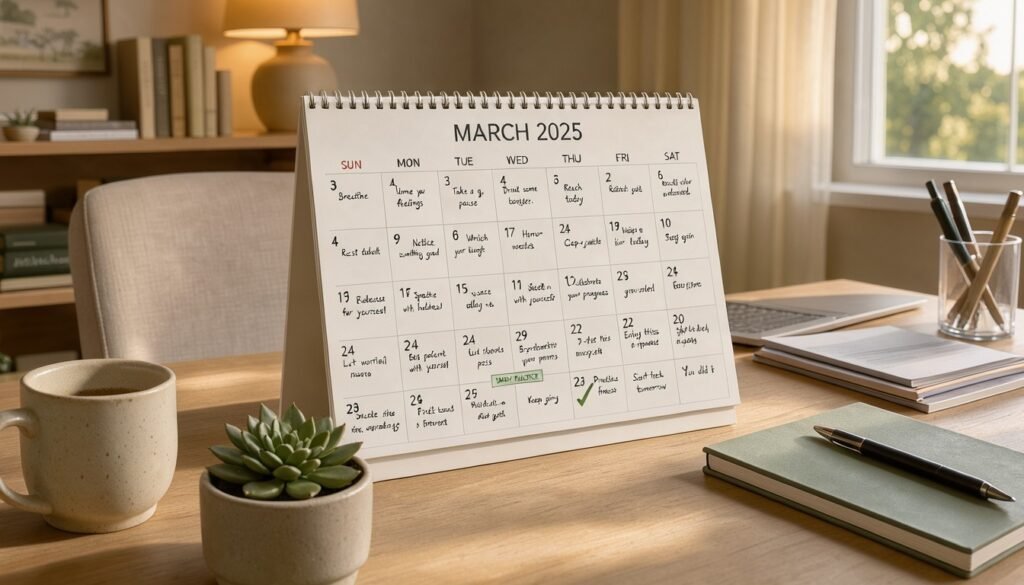
A desk calendar open to the current month has a check mark beside a mental fitness practice, with small inspirational phrases on each day. A coffee mug, succulent, and notebook sit on the organized home office desk, with a window and cozy room in the background.

  1. Pick one habit that you want to practice.
  2. Connect it to a routine you already follow.
  3. Mark each attempt with a simple check.

Frequency, timing, behaviour type, personal choice, feelings about the habit, behavioural regulation, and preparation can all affect habit strength. Self-chosen habits and morning practices generally showed greater habit strength. Your mind doesn’t need a makeover. It needs a warm-up.

Myth: mental fitness means never feeling bad

Mental fitness includes difficult feelings and practising how to meet them. Exercises can be brief everyday practices, such as labelling a feeling or taking a breathing pause; examples include noticing a mood before it takes over or recovering thoughtfully from a tense email.

Mental fitness and mental health are related but distinct: fitness describes trainable daily capacities, while mental health includes your wider wellbeing and care needs. Difficult days are not proof that your practice has failed. Pick the habit that feels easiest to repeat, not the one that looks most impressive.

Name the Feeling and Breathe Before Reacting

Before you send the reply, pause to notice what you’re feeling. Naming an emotion and taking a slow breath can create space between a stress trigger and your next move. That space matters when a sharp work message lands at the wrong moment.

If you notice anxiety before replying, try saying, “I’m feeling anxious,” then check what prompted it. Research on emotion labelling suggests that naming a feeling can reduce its intensity, helping you pause rather than react automatically. Try it today when a conversation or message tightens your shoulders. On a difficult day, simply naming one emotion in a single word counts.

A woman in her late 30s sits at a kitchen table, glancing at her smartphone while fidgeting with a pen. A bowl of fruit, wooden accents, and family photos surround her in a modern home.

Put a clear label on the emotion

A specific word, such as frustrated, worried, or disappointed, gives you a clearer starting point than “bad.” Notice what happened just before the feeling showed up.

Take a two-minute breathing reset

A gentle two-minute breathing pause can help you choose before answering a stressful message or joining a tense conversation. In a 2025 experiment with 27 participants, slow breathing reduced anxiety compared with fast breathing, including while participants anticipated uncertain threats. Slow breathing reduced anxiety in that experiment, though individual responses can differ.

Keep the breath comfortable; there is no need to force a deep inhale or hold it.

  1. Pause before sending the reply or entering the conversation.
  2. Breathe slowly for two minutes, at a comfortable pace.
  3. Choose your next action after the pause.

If two minutes feels out of reach, take one slow breath. Brief evening reflection may also support sleep and mood: writing worries down can make them feel less mentally occupying at bedtime, while noticing the day supports mood awareness.

A feeling you can name is easier to meet with a choice.

Use Micro-Movement to Clear Mental Fatigue

If your focus is fading after another screen-heavy hour, give your body a brief chance to move. Micro-breaks of 10 minutes or less have shown small improvements in vigour and fatigue. A short reset can help you feel less drained, though it does not automatically improve performance.

In a 2022 meta-analysis of 22 study samples with 2,335 people, vigour increased, and fatigue decreased after micro-breaks. The overall performance effect was not statistically significant, so treat movement as a recovery tool, not a productivity hack. Micro-breaks of 10 minutes or less showed small well-being effects in the analysis.

  • Take a five-minute walk around the block or building.
  • Stand and stretch between two tasks.
  • Walk a flight of stairs at a comfortable pace.

A minute of standing and stretching is the minimum version for a day without five spare minutes. Try one five-minute movement break between two tasks today.

A young Asian American woman in athletic clothes walks along a paved path through a city park, bordered by green trees and colorful flower beds. Nearby, people read and talk on benches, while office buildings rise beyond the trees under a blue sky.

Keep a Brief Note of What Went Well

A useful evening note does not need to turn a rough day into a highlight reel. Honest noticing is the point: gratitude practice can help you register something real, even when the rest of the day was a slog.

A 2023 review of 6randomiseded clinical trials found that people receiving gratitude interventions reported more positive mood and emotions. The review also found greater feelings of gratitude, better mental health, and fewer anxiety and depression symptoms. That is an association with the practices, not a promise that a note will fix a hard day.

A young woman writes in a mental fitness journal at a wooden desk, with one hand holding a pen. A steaming cup of tea, colorful pens, houseplants, personal mementos, and a bookshelf of wellness books surround her.

Try it today: write one line about the best part of your day, or note three good things if that feels natural. A useful moment might be a kind text, a meal that hit the spot, or a task you finally finished.

A mental fitness journal can be a paper note, a phone note, or a sentence shared with someone. The repeatable reflection matters more than the format. On a bad day, write one word or one short sentence about something that felt good, useful, or kind.

Gratitude works best when it tells the truth about your day. No forced sunshine required. Write one honest sentence about a moment you would like to remember.

Set a Small Digital Boundary

If your day starts with a scroll before you’ve even sat up, try changing that first moment. A phone-free first 20 minutes after waking is one possible boundary, not a virtue test. You are choosing where your attention goes first.

Place your phone beyond arm’s reach before bed, then do one first-morning activity before checking it. Get dressed, drink water, or open the curtains.

A smartphone sits just beyond reach on a kitchen counter beside a steaming cup of coffee and an open notebook with handwritten notes. A wooden table holds oatmeal and fresh fruit, while shelves in the background display books and houseplants.

If you need your phone for an urgent responsibility, choose another boundary. Parents, shift workers, and anyone on call may prefer a screen-free meal or a set time to check nonessential apps.

The minimum version is waiting until you get out of bed before opening an app. These daily habits for mental health should serve your needs, not create guilt. The goal is a more deliberate use of time, even if the change is small.

“A boundary is a small choice about what gets your attention first.” Set up tonight’s phone placement before you go to bed.

Make One Real Connection Each Week

One sincere check-in can feel more human than a week of reacting to group chats. A real conversation can offer connection and support, without becoming another task to optimise.

Contact one person this week, ask a specific open question, and listen without multitasking. Try “What has been taking up most of your energy lately?”

A woman with light brown hair in a ponytail, wearing a sweater and jeans, walks beside a man in a T-shirt and shorts as they talk on a tree-lined suburban park path. Green trees, blooming flowers, and distant park-goers surround them.

A busy parent or professional might make a short call during a walk or catch up over lunch. Make a little room for one person and their actual answer.

Relationships are not measured by how often you post or respond. “How are you really doing?” can be the minimum version. Follow up when both of you have time for a conversation.

“Connection is not another task to perfect; it is a small way to be with someone.” Choose one person and send a message that invites a real answer.

Empty Your Mind Before Bed

If tomorrow’s to-dos are circling as you turn out the light, give them somewhere to land. A brain dump is a brief written offload, not a demand to solve everything before bed.

Write down what is on your mind, what you can do tomorrow, and what can wait. This gives worries somewhere outside your head to sit.

A middle-aged woman in pajamas writes in an open journal at a small desk beside a window, with a cup of herbal tea nearby. A quilt covers the bed behind her, houseplants sit in the room, and stars show in the night sky.

Writing worries down may help some people feel less mentally occupied at bedtime. Brief evening reflection may support sleep by putting worries on paper, and mood by helping you notice the day. Research also suggests naming an emotion can reduce its intensity.

On a bad day, write one worry and one next step, or simply name what can wait. The note can be brief, plain, and unfinished.

Tonight, use the prompts “What is on my mind?”, “What can I do tomorrow?”, and “What can wait?” One line is enough when that is all you have. Write down one worry and one thing that can wait until tomorrow.

Conclusion

Small habits can support emotional wellbeing without requiring a new schedule or a permanently cheerful mood. If distress is persistent, overwhelming, or interfering with daily life, talking with a licensed mental health professional is a sensible form of care, not a failure.

Small does not mean insignificant; it means easier to return to. Save this short checklist for a day when your brain has too many tabs open:

  • Name one feeling.
  • Take a slow breath.
  • Move briefly.
  • Write one good moment.
  • Set one digital boundary.
  • Contact one person.
  • Put one worry on paper.

There is no special badge for making a habit complicated. Choose one to try this week, then tell us in the comments: Which of these habits do you already do without realising it, and how did your chosen habit feel?


FAQ

What should I do if I miss a day of a new habit?

Resume at the next natural cue, and return to the small version instead of doubling the effort. Missing a day is a normal part of building a routine, not proof that you have lost your progress. For example, if you skipped a breathing pause after lunch, try one comfortable breath after your next meeting. Keep the restart easy enough to do.

How can I tell whether a mental fitness habit is helping?

Look for a small change in how quickly you pause, recover, or return to your next task. A useful habit does not need to give you a permanently good mood. You might notice that you catch tension before sending a sharp reply, or that a rough moment takes less time to shake off. Those small shifts can be worth noticing.

Do I need an app to start building mental fitness?

No, an app is optional; a paper note, a simple reminder, or a routine cue can support practice. You could keep a pen beside your coffee mug or use a check mark on a calendar. If an app genuinely makes the habit easier to remember, use it. The tool matters less than whether you return to the practice.

Can a breathing reset feel uncomfortable for some people?

Yes, focusing on the breath can feel uncomfortable for some people. If that happens, return to comfortable, ordinary breathing and choose another brief pause instead. You might stand, stretch, or look out a window for a moment. A reset should feel like a manageable choice, not another challenge you have to push through.
Tags: Daily mental health habitsEmotional resilienceEmotional Well-beingMental fitnessMental HealthMindfulnessStress Management
50 Wellness Resources 50 Wellness Resources 50 Wellness Resources
Previous Post

Stress Recovery: Small Ways to Reset During Overloaded Weeks

wellnessandus.com

wellnessandus.com

Discussion about this post

Recommended

Man with weight training equipment exercising in sport gym club

Loose Weight Fast: Ditch the Weight, Embrace Your Best Self with Expert Tips

3 years ago
Healthy Joints: The Foundation of Lifelong Movement

Healthy Joints: The Foundation of Lifelong Movement

8 months ago

Don't Miss

Mental fitness

Mental Fitness: Small Habits That Support Emotional Well-Being

November 28, 2026
stress recovery

Stress Recovery: Small Ways to Reset During Overloaded Weeks

November 28, 2026
gut health tracking

Gut Health Tracking: What Symptom and Food Logs Can Tell You

November 24, 2026
Neurowellness & Mental Fitness

Neurowellness & Mental Fitness: Train Focus and Build Resilience

November 28, 2026
50 Wellness Resources
Wellness and Us Magazine

At Wellness and Us, our mission is to empower our readers with accurate and up-to-date information supported by published medical and health articles. We believe that everyone deserves access to trustworthy resources for making informed decisions about their health and wellness.

Follow us

Recent News

Mental fitness

Mental Fitness: Small Habits That Support Emotional Well-Being

November 28, 2026
stress recovery

Stress Recovery: Small Ways to Reset During Overloaded Weeks

November 25, 2026

Categories

  • Blog
  • Disease
  • Eyes Health and Vision
  • Fitness
  • Health
  • History
  • Kids Health
  • Lifestyle
  • Longevity
  • Medical Innovations
  • Medications
  • Mental Health
  • News
  • Nutrition
  • Oral Health
  • Research
  • Weight Loss
  • Wellness
  • Women Health

Tags

AI-Powered Medical Care Artificial Intelligence in Healthcare Blood Sugar Control Breathwork exercises Cancer Clean Eating Coping Strategies Diabetes Diet Tips Digestive health Digital Wellness Emotional Well-being Future of Healthcare Gut health tips Health Benefits Healthcare Transformation Health Symptoms Healthy Aging Heart Attack Holistic Wellness Kidney health Machine Learning in Medicine Men's Health Mental Health Mental Health Advocacy Mental Well-being Mind-body balance Mindfulness Meditation Mindfulness Practices Nutrition Prebiotic Foods Pregnancy Probiotics Relaxation exercises Relaxation Techniques Self-care practices Self-care Strategies Skin Care Stress Management Stress reduction techniques Sugar-free diet Sugar detox Wellness Women's Health Youthful Skin
  • About
  • Advertise
  • Privacy & Policy
  • Contact

© 2023 Wellness and Us - All Rights Reserved - Designed by Online Net1.

Welcome Back!

Login to your account below

Forgotten Password?

Retrieve your password

Please enter your username or email address to reset your password.

Log In

Add New Playlist

No Result
View All Result
  • Home
  • Health
  • Weight Loss
  • Our Channel
  • Disease
  • Fitness
  • Nutrition
  • Lifestyle

© 2023 Wellness and Us - All Rights Reserved - Designed by Online Net1.

This website uses cookies. By continuing to use this website you are giving consent to cookies being used. Visit our Privacy and Cookie Policy.
Go to mobile version