
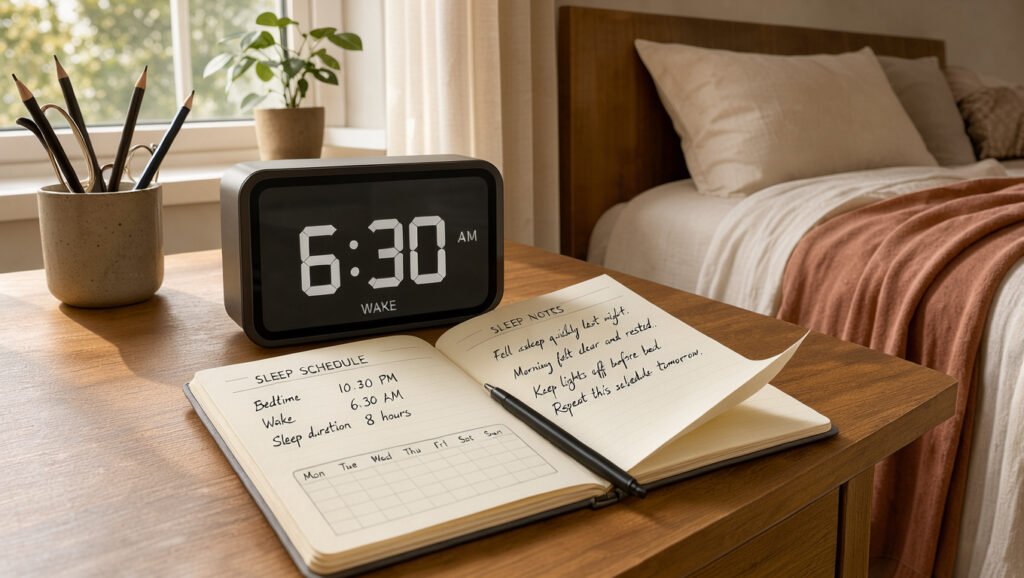
A consistent wake time can give sleep habits a steadier daily anchor without requiring a perfect bedtime. The National Sleep Foundation expert panel reached consensus that regular sleep-onset and wake-up times are important for health, safety, and performance. Could a repeatable morning matter more than getting bedtime exactly right? A realistic wake cue can help you notice your patterns, even when life makes every night different.
The evidence concerns regularity in both sleep onset and waking, not a rule that everyone must follow one schedule. A steady morning can be a useful place to begin if your work, family, or school obligations make sleep timing hard to manage. You can look for patterns without treating a late night as failure or expecting every day to match. This report explains what the research measures, what it can and cannot tell you, and how to find a routine that fits ordinary life. Consistency is a practical goal, not a promise of perfect sleep.
Key Takeaways
- A repeatable wake time can give you a clear point for observing sleep habits.
- Regular timing and sleep duration describe different parts of sleep health.
- Research reports associations, not guarantees about an individual’s health.
- Work days and non-work days may create different sleep patterns.
- A routine should leave enough opportunity for sleep and fit your obligations.
- A week of observations can help you see patterns without grading each night.
Treat your schedule as a pattern to learn from rather than a nightly scorecard.
Sleep Regularity: What the Measure Captures
Sleep regularity describes how consistently your sleep and wake timing repeats from one day to the next. The Sleep Regularity Index (SRI) compares whether you are asleep or awake at matching time points on consecutive days, 24 hours apart. It captures repeated sleep-wake patterns, not the number of hours you sleep.
A person could sleep for a similar duration each night while going to bed and waking at different times. Another person could keep sleep timing steady but spend too little time asleep. These patterns differ, even if a single night’s estimated duration looks alike. Sleep duration measures time asleep; sleep regularity describes how that sleep and waking recur across days.
The SRI can reflect changes in sleep onset and wake time because both affect whether you are asleep at corresponding times on successive days. Researchers use different sleep parameters to describe regularity, and the measures do not all respond identically to naps, awakenings, or shifting schedules. A week of wrist-accelerometer recording was used in the UK Biobank mortality study.
Regularity describes the shape of your sleep-wake pattern across days, not the length of one night.
Wrist devices estimate sleep and waking from movement signals. They can help reveal broad sleep-wake patterns, but an estimate is not the same as a clinical assessment. When you compare sleep timing, look at the repeated pattern rather than treating one device reading as definitive.
Think of regularity as the shape of a week, not the length of a single night.
Why a Steady Wake Time Can Anchor Your Routine
A repeatable wake cue gives you one clear point to observe as you build steadier days. A morning alarm can help you notice how bedtime, sleep onset, and daytime alertness shift around a familiar time. That reference point makes changing habits easier to see. A wake cue is a practical starting point, not a complete measure of sleep health.
A repeatable cue for the day
Your body coordinates recurring daily rhythms across a 24-hour circadian cycle. Light and regular activities can act as cues within that cycle. A familiar wake time gives the day a recurring beginning, making it easier to compare how you feel after different evenings.

For example, a 7:00 a.m. alarm might fit a person who needs to get ready for work or school. That time is illustrative, not a recommended hour for everyone. If the cue fits your actual obligations, you can observe whether sleep onset moves earlier or later and whether daytime alertness changes.
A practical starting point, not a perfect rule
Sleep regularity concerns both sleep-onset and wake times. Emphasizing waking offers one manageable place to begin, not a reason to ignore bedtime or sleep duration. Someone with evening caregiving duties, a long commute, or a changing start time may need a different cue than someone with a fixed morning.
Trying to force one universal clock time can make a routine less workable. If you regularly wake before you have had enough time to sleep, the cue needs reconsideration. A practical pattern gives you a way to notice what changes, while leaving room for real responsibilities and occasional disruptions.
Choose a wake time that fits your obligations well enough to repeat.
Sleep Duration Still Matters Alongside Timing
A steady schedule works best when it also leaves most adults room for 7-9 hours of sleep. The National Sleep Foundation recommends that range for most adults. Regular timing does not make a shorter night adequate. Your wake cue should preserve a realistic opportunity to sleep.
Sleep duration and sleep timing are different dimensions of sleep health. Duration refers to how long you sleep; timing describes when sleep and waking occur. A schedule can be consistent yet allow too little time in bed, while another can provide enough time asleep with changing bedtimes and wake times.
Imagine one person sleeping about the same number of hours each night but waking at different times. Another person sleeps a similar amount while keeping sleep onset and waking more consistent. The example illustrates a difference in timing patterns, not a claim that either schedule produces a particular health outcome.
Daily obligations can shrink the time available for sleep. A very early wake time may not fit a late work shift, a long commute, or responsibilities at home. If you move your wake cue earlier, consider whether your evening schedule leaves enough room for sleep rather than assuming your body will adapt without cost.
Duration remains important even when regularity is your starting point. The adult recommendation is a general target, not a guarantee that every person’s needs are identical. A steady schedule should support adequate sleep opportunity instead of becoming a reason to cut it short.
Set the wake cue around a realistic sleep opportunity, not at the expense of it.
What the National Sleep Foundation Consensus Covers
The panel’s consensus addresses regular timing as well as what may help when workday sleep falls short. The National Sleep Foundation panel reviewed 63 full-text publications and concluded that regular sleep timing matters for health and performance. Its guidance also considers catch-up sleep on non-work days after insufficient sleep on work days. These points address both schedule consistency and sleep opportunity.
Regular bedtimes and wake times are the focus of the panel’s sleep regularity consensus. The panel’s conclusions connect timing with health, safety, and performance. Its review of the evidence supports treating regular timing as relevant, while recognizing that work schedules and other obligations can constrain sleep.
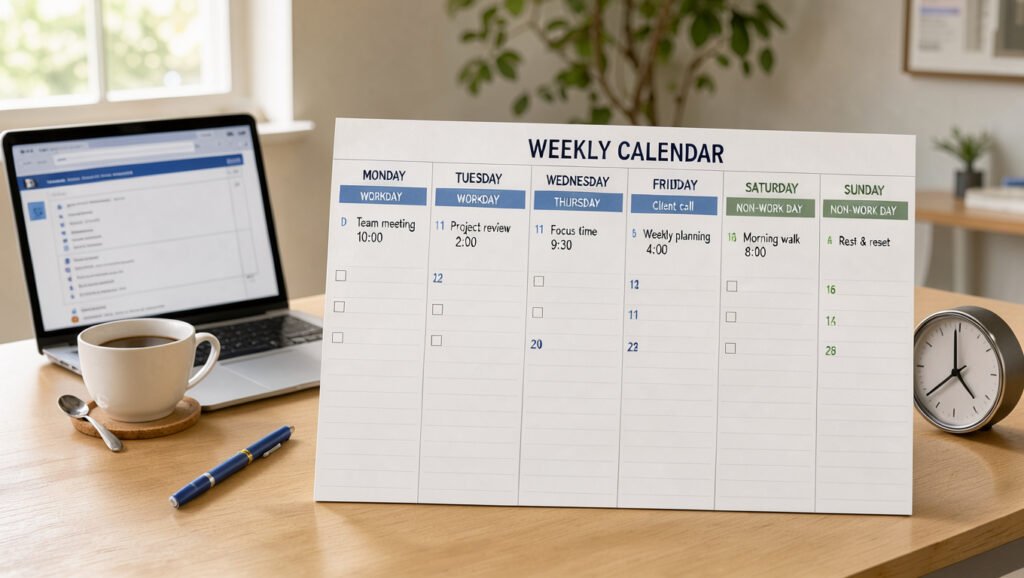
The consensus does not mean that you must keep identical hours under every circumstance. It recognizes that extra sleep on non-work days may benefit health when sleep has been insufficient on work days. That conditional point matters: the situation is not the same as choosing later hours without a sleep shortfall.
The National Sleep Foundation summarizes the panel’s sleep timing consensus guideline on consistent bedtimes and wake times. Its conclusions place regularity alongside other sleep needs, rather than treating a steady clock time as the only goal.
For readers, the practical meaning is balanced: regularity can matter, and making up sleep may also have a role after insufficient workday sleep. A schedule should account for when obligations occur and whether your sleep opportunity is adequate.
Keep both needs in view: a repeatable schedule and adequate sleep opportunity.
What the UK Biobank Mortality Study Found
In the UK Biobank cohort, the most-regular sleep groups had lower associated mortality risks than the least-regular group. The analysis included 60,977 participants and compared the four most-regular groups with the least-regular group. The findings are associations, not proof that regular timing caused the difference. The reported ranges compare groups, not individual outcomes.
All-cause mortality
For all-cause mortality, the four most-regular groups had associated lower risk ranges of 20%-48% compared with the least-regular group. The study adjusted for age, sex, ethnicity, and sociodemographic, lifestyle, and health factors. Adjustment helps account for measured differences, but it does not turn an observational result into a causal conclusion.
The study used wrist-accelerometer recordings to assess sleep regularity. Mean follow-up after recording was 6.30 ± 0.83 years, and mortality was reported for up to 7.8 years. The follow-up period describes how long outcomes were tracked, not a forecast for an individual reader.
Cancer and cardiometabolic mortality
The analysis also reported lower associated risks for cancer and cardiometabolic mortality. Those outcomes had separate comparison ranges. The table keeps each outcome next to the same comparison group so the figures are not mistaken for risks faced by an individual.
| Outcome | Comparison | Associated lower risk range |
|---|---|---|
| All-cause mortality | Four most-regular groups versus least-regular group | 20%-48% |
| Cancer mortality | Four most-regular groups versus least-regular group | 16%-39% |
| Cardiometabolic mortality | Four most-regular groups versus least-regular group | 22%-57% |
For each outcome, the comparison is between categories of regularity in a prospective cohort. A group-level association cannot tell you what will happen to one person, and the analysis does not establish that changing a schedule alone changes mortality risk.
Read each percentage as a comparison between groups, not as an individual prediction.
How Sleep Regularity Compares With Sleep Duration
In the UK Biobank mortality analysis, sleep regularity was the stronger all-cause mortality predictor in equivalent models. Researchers compared sleep regularity and sleep duration in models designed to make that comparison. For that analysis, regularity predicted all-cause mortality more strongly. The finding applies to the study’s models and that specific outcome.
A predictor in a cohort model is a variable associated with an outcome across a group. It is not a personal guarantee, a diagnosis, or proof that changing the predictor will change the outcome. The result also does not show that sleep duration has no value. It compares the predictive strength of two sleep measures in one analysis.

Sleep duration remains a separate part of sleep health. The comparison gives readers a reason to pay attention to timing consistency, but it does not support trading adequate time asleep for a more orderly schedule. A person who sleeps too little does not resolve that problem by keeping the same bedtime and wake time.
The study’s result is specific to all-cause mortality and the equivalent models used. It does not establish the same ranking for every health outcome or every person. Differences in health, work, and daily obligations shape how a schedule can be used in practice.
In everyday terms, consistency can be worth noticing alongside duration. Neither measure should be treated as a substitute for the other, and neither offers a personal prediction from a group result.
Use the comparison to value consistency alongside, rather than in place of, adequate sleep.
What Sleep Regularity May Mean for Mental Health
A large UK Biobank analysis linked more regular sleep with lower associated risks of both depression and anxiety. Among 79,666 participants without depression or anxiety at baseline, regular sleepers had 38% lower associated depression risk and 33% lower associated anxiety risk than irregular sleepers. The associations were observed over a median follow-up of 7.5 years. They do not show that regular sleep prevents or treats either condition.
Participants who slept irregularly but met recommended sleep-duration guidelines still had elevated associated risks compared with the study’s regular-sleep reference group. That finding suggests duration alone did not account for the pattern reported in this analysis. It does not mean that a sleep schedule can explain every person’s mood or anxiety symptoms.
The study followed people who did not have depression or anxiety at baseline. This design helps describe later associations in that group, but it cannot determine what caused an individual’s mental health to change. Health, work, stress, and other experiences may affect both sleep patterns and mood.
Sleep regularity can be one part of a broader picture of mental health. A schedule may help you notice changes in sleep onset, waking, or daytime functioning, but it cannot diagnose depression or anxiety. A sleep pattern that feels steady also does not rule out a mental health concern.
If low mood, loss of interest, persistent worry, or anxiety symptoms continue, seek support based on the symptoms themselves. You do not need to prove that your sleep caused them before reaching out. A healthcare professional can consider your sleep, health, and daily circumstances together.
Persistent depression or anxiety symptoms deserve a conversation with a healthcare professional.
What Can Disrupt Circadian Timing?
Light exposure and changing daily obligations can shift sleep timing in different directions across the week. Evening light, early starts, or late social plans may make sleep onset and waking less predictable. Changing cues can pull your sleep-wake patterns out of step with one another. Notice which parts of your week most often change your timing.
Changing light and daily cues
Your circadian system coordinates recurring daily rhythms, and light is one environmental cue that can influence timing. A bright evening or a different morning routine may change when sleep feels possible. Physical activity and other regular daily activities can also become cues in the day.
- Evening or changing light exposure
- Work or school start times
- Social plans that shift bedtime or waking
- Rotating work schedules
Schedules that shift across the week
Work or school may require an early wake time on some days, while social plans push bedtime later on others. Rotating work schedules can change when you need to sleep and wake, including times when daytime sleep is necessary. These demands can create variability without reflecting a lack of effort.
The National Sleep Foundation consensus panel linked consistent sleep and wake times with outcomes involving alertness, cardiovascular and metabolic health, inflammation, and mental health. The panel’s health and performance findings describe areas associated with timing, not a promise that a fixed schedule will prevent a specific condition.
Small shifts in outside cues can add up across several days. You might notice that a late social evening affects the next morning, while a changing start time shifts both sleep onset and wake time. Track the cue that moves your schedule most often before deciding what could be adjusted.
Notice which changing cue most often moves your sleep or wake time.
Weekend Catch-Up Sleep and Workday Sleep Debt
Extra sleep on a non-work day can be part of responding to insufficient sleep on work days. The National Sleep Foundation panel concluded that catch-up sleep on weekends or other non-work days may benefit health when workday sleep is insufficient. The condition matters: the finding concerns a shortfall on work days. Work days are days with fixed obligations, not necessarily Monday through Friday.
To understand your own pattern, compare sleep onset and wake times across a typical week. Notice when you sleep on work days, then compare those times with non-work days. A later wake time may reflect a chance to recover sleep, a shift in social timing, or both.
Extra sleep and timing consistency can pull in different directions. Sleeping later may give you more time asleep after a short night, while a large timing shift can make the next day’s schedule feel less familiar. The panel’s conclusion allows for possible benefit after insufficient sleep; it does not say that every later morning is needed.
Your work pattern may run on weekends, rotate, or change from week to week. Label days by whether you have fixed obligations, then compare similar kinds of days. That makes the pattern more useful than treating Saturday and Sunday as universal non-work days.
Judge the pattern across your own work and non-work days rather than by the weekend label alone.
Build a Wake-Up Routine You Can Repeat
A wake-up routine is easier to repeat when its first cue and next action are simple. A consistent reference point helps you observe sleep timing, while daylight and regular activity can support the routine. Keep the steps manageable enough for ordinary mornings. A useful routine fits your real obligations instead of an idealized schedule.
Make waking predictable
Start with a wake time that works with your usual responsibilities. Preparing for it the night before can remove small morning decisions, such as where you left your alarm or work badge. The cue should be clear, but it does not need an elaborate setup.

Add a simple morning sequence
The wake cue is the routine’s fixed reference; the next activity can stay simple and personal. Daylight after waking, when practical, provides an environmental cue. A familiar activity can make the first part of the day easier to repeat without turning the morning into a checklist of demands.
- Choose a workable wake time.
- Prepare the alarm and morning essentials the night before.
- Get daylight after waking when practical.
- Attach one simple activity, such as breakfast or a short walk.
- Record whether the routine was workable.
Regular daily activity can make a morning feel more structured, but your sequence does not need to be long. A short walk may suit one person, while breakfast or a quiet few minutes suits another. Ordinary obligations should guide the choice.
Notice whether the cue fits the time you need to leave, care for someone, or begin work. If it makes the day harder or leaves too little sleep opportunity, it is not a workable anchor. Small adjustments can preserve the idea without forcing an unsuitable clock time.
Keep the routine small enough to use on an ordinary morning.
Track Your Sleep Patterns Without Chasing Perfection
A week of simple notes can reveal whether your sleep and wake times are settling into a pattern. A sleep diary can record sleep onset, waking, estimated duration, and daytime alertness without treating one night as a verdict. Look for the pattern across entries. A sleep diary kept for a week or longer can help a healthcare professional assess sleep and wake times when evaluating delayed sleep phase.
Keep the entries simple enough to complete consistently. Estimates are useful as observations, not exact measurements, and a difficult night does not erase the rest of the week. Record how the day went alongside the timing, since functioning can add context to the numbers.
- Attempted bedtime or estimated sleep onset
- Final wake time
- Estimated time asleep
- Daytime alertness or difficulty functioning
Consumer wearables estimate sleep from recorded signals such as movement. Their day-to-day estimates can offer clues about patterns, but they are not a clinical diagnosis. A clinician considers symptoms and context when evaluating sleep, including how a schedule affects daily life.
A diary may make it easier to describe irregular sleep or difficulty waking than relying on memory alone. Sleep medicine professionals can use a week or more of sleep and wake notes when evaluating delayed sleep phase. Bring the notes if you need help assessing a delayed schedule.
Bring a week or more of sleep and wake notes to a healthcare professional if you need help assessing a delayed schedule.
When a Delayed Sleep Phase Needs Attention
A delayed sleep phase can make sleep and waking feel out of step with required daily hours. The pattern means sleep timing stays later than your desired or required schedule, making it difficult to fall asleep earlier and wake when needed. Persistent timing matters more than one late night. When the pattern repeatedly interferes with daily life, professional support can help.
Recognize the timing pattern
Someone with a delayed pattern may feel unable to fall asleep at the time needed for an early start, then struggle to wake on time. This is different from a single bedtime shift after a social event. The concern is a recurring mismatch between sleep timing and required hours.

Get support for persistent difficulty
Difficulty meeting work, school, or family obligations can be a reason to discuss the pattern with a healthcare professional. They can consider how long it has been happening, your symptoms, and other factors that affect sleep. A schedule record can help describe the timing without relying on memory.
Mayo Clinic recommends going to bed and getting up on a regular schedule, including on weekends, as part of delayed sleep-phase treatment guidance. The recommendation points to regularity as one part of care, not a guarantee that a schedule change alone will resolve every case.
Sleep timing can also be affected by health conditions, medication, or daily demands. If the mismatch persists, a healthcare professional can help assess whether delayed sleep phase or another issue may be involved. Avoid diagnosing yourself from a late schedule alone.
If a delayed schedule repeatedly disrupts daily life, discuss it with a healthcare professional.
Adapt the Routine for Shifts and Variable Obligations
A rotating schedule calls for a workable anchor around the shifts you actually have. Rotating shifts can require sleep at changing times, including daytime sleep, so one fixed clock-time wake cue may not fit. Compare workable patterns around your obligations. The goal is to find cues that can repeat within the schedule you have.
Find a workable anchor around rotating shifts
Work days and non-work days describe whether you have fixed obligations; they do not imply that every work schedule follows the same weekly pattern. When shifts change, the sleep opportunity may need to move too. A useful reference can be a recurring point within a particular shift pattern.
Separate a changeable week from a fixed routine
It may be more useful to compare similar shifts than to expect every day to match. A person moving between day and night work may have different sleep and wake times for each pattern. Keeping the patterns separate helps show what is repeatable and where the schedule changes.
- Identify the most stable wake opportunity within a shift pattern.
- Keep a short record when the schedule changes.
- Plan a suitable sleep opportunity around each shift.
- Compare like-with-like days rather than expecting every day to match.
Other variable obligations can create a similar challenge, even without rotating work. Care duties, school hours, or changing start times may make a fixed wake time unrealistic. Focus on identifying the cues and sleep opportunities that fit each real schedule.
Review each shift pattern on its own terms before deciding what routine is repeatable.
Troubleshoot Setbacks Without Abandoning the Routine
A setback is easier to work with when you return to a workable cue instead of restarting from scratch. A gradual schedule adjustment of about 15-30 minutes every few days is a common rule of thumb. Small shifts may be easier to maintain than a sudden large change. A routine may take several weeks to feel settled.
Adjust after a late night
One late night does not erase a sleep pattern. The next step is to return to a workable cue and notice whether the change affected sleep onset, waking, or daytime functioning. Avoid turning a single disrupted night into a judgment about the whole routine.
Respond to travel and changing plans
Travel, social plans, and new work or school hours can all move sleep timing. Adjustments may take several weeks to feel settled, with the pace shaped by the size of the change and daily obligations. These situations call for a response that fits the disruption rather than a rigid demand for identical nights.
- One late night: return to a workable cue rather than abandoning the routine.
- A weekend with later plans: allow for the change, then resume a familiar pattern.
- Travel across time zones: expect local timing to differ and adjust in manageable steps.
- A change in work or school hours: shift the routine gradually around the new obligations.
The 15-30-minute rule of thumb describes a gradual adjustment every few days, not a deadline. A larger change may take longer to feel familiar, while daily obligations can limit how quickly you can shift. Keep the adjustment small enough to use through ordinary days.
Make the next adjustment small enough to keep using it through the week.
How to Judge Progress Without Chasing a Perfect Night
Progress is easier to recognize across a week than by judging one difficult night. Compare sleep onset, wake patterns, estimated duration, and daytime alertness across seven daily entries. The broader view can show whether a routine is becoming more workable. Occasional variation is information, not proof that the routine has failed.
A week may include a later bedtime, a rough morning, or a day when obligations change. Consider those entries alongside the rest rather than treating them as the whole story. Estimated sleep duration can help you see whether the schedule provides enough opportunity for sleep.
Daytime experience matters alongside clock times. You might notice that a consistent wake pattern feels manageable, or that alertness remains difficult despite a routine. Those observations can help you decide whether the pattern works in ordinary life.
Keep a routine that supports both repeatable timing and enough opportunity for sleep.
A schedule does not need to produce identical nights to be useful. Your work, social plans, and health can create variation, and the point is to understand the pattern rather than demand perfection. If the routine regularly leaves you short on sleep, its timing may need to change.
Keep the routine that supports both a repeatable schedule and enough time for sleep.
Conclusion
A steadier sleep pattern can begin with one wake time you can realistically repeat. Consistency in both sleep onset and waking is worth noticing, while adequate sleep opportunity remains part of the goal. You do not need to make every night identical to learn what supports your days.
Choose a workable wake time and record your sleep and wake times for a week. That simple record can help you see what fits your obligations and where your schedule changes. Choose that wake time today and start a simple week of observations.