

A useful appointment starts with a few weeks of symptom notes, a short list of questions, and the health information that helps your clinician understand the pattern. Good preparation can make it easier to describe what has changed, how often it happens, and what you hope to learn. You do not need to diagnose yourself before you go.
Changes can affect sleep, work, relationships, and the routines that usually feel simple. A healthcare professional can help you consider what may be happening and discuss next steps. This guide helps you gather the details and questions that make the conversation more focused, without turning your notes into a diagnosis.
Key Takeaways
- Track changes for a few weeks and note their effect on daily life.
- Mark the symptoms that interfere most with sleep, work, or relationships.
- Bring menstrual details and relevant health information to the appointment.
- Choose a few questions that match your main goal for the visit.
- Write down the agreed plan and any next steps before you leave.
Bring the notes and questions you have prepared, even if your symptoms have changed since you started tracking them.
How to Organize Menopause Symptoms Before an Appointment
A useful symptom log records how often each change happens, how severe it feels, and what it disrupts in daily life. Patterns matter, so track symptoms for a few weeks instead of relying on memory during a busy visit.
Signs you may be struggling with menopause symptoms include changes that regularly interrupt sleep, work, relationships, or routine activities. Give the most disruptive symptoms priority, even when they happen less often than milder changes.

Track symptoms and their effect on daily life
For each symptom, record how often it occurs, how severe it feels, and what it changes in your day. Use plain descriptions, such as waking twice at night or leaving a meeting to cool down.
Consider whether hot flashes or night sweats, sleep trouble, mood changes, vaginal dryness, or joint or muscle pain are affecting you. Symptoms hot flashes may be easy to count, while changes in mood or comfort may need a brief note about the situation.
Prioritize the symptoms that interfere with sleep, work, relationships, or routine activities.
Menopause-associated symptoms range from minor to severe. They can include hot flashes and sweats, vaginal dryness, mood effects, joint and muscle pain, and sexual difficulties. A note about what you could not do helps make the impact clear.
| What to record | Details to note | Example symptom | Daily-life impact |
|---|---|---|---|
| Frequency | How often it happens | Hot flashes, four times today | Interrupted a work meeting |
| Severity | Your rating or description | Night sweats, severe | Needed to change sleepwear |
| Daily-life effect | What it disrupted | Mood changes, tense afternoon | Made a conversation difficult |
| Menstrual pattern | Frequency, duration, or last period | Periods farther apart | Harder to predict bleeding |
Record menstrual changes alongside symptoms
If periods continue, write down their frequency, duration, and any changes you notice. If they have stopped, note when your last period occurred. A calendar entry can be more useful than trying to recall the dates later.
Include changes that seem unrelated at first, such as whether a symptom follows a poor night of sleep. Mark the two or three symptoms that most affect your routine so they are easy to raise during the visit.
When Do Symptoms Start, and How Long Can They Last?
Symptoms can begin during perimenopause, often before periods stop, and can continue for years after the transition begins. The pattern is personal, but most people begin the menopausal transition between ages 45 and 55.
Menopause symptoms often start during perimenopause, which may last several years. In the United States, the average age of menopause is 52. Menopause is confirmed after 12 consecutive months without a menstrual period or spotting.
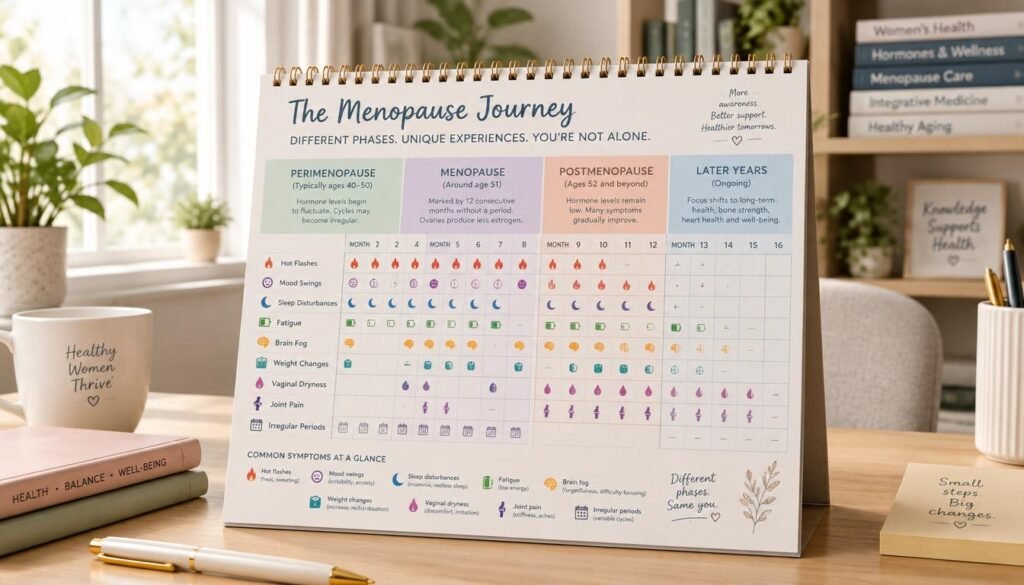
The National Institute on Aging explains the usual timing, symptoms, and health effects in its menopause overview. Symptoms can last between 2 and 8 years, though their timing and pattern differ among individuals.
How long do menopause symptoms last? They can continue for 2 to 8 years, and some symptoms may remain after the final period. In women, menopause symptoms do not follow one fixed schedule; the experience may change over time.
Menopause before age 45 is called early menopause. Menopause before age 40 is called premature menopause. Primary ovarian insufficiency before age 40 is different: periods may be irregular, and pregnancy may still be possible.
Menopause happens after the final menstrual period, but the transition can begin earlier. A period that becomes less predictable does not, by itself, establish when menopause will occur.
Record the date of your last period, or note that your cycle is continuing with changes.
Bleeding Changes and Symptoms to Flag Promptly
Heavy bleeding, periods lasting more than a week, and bleeding after a year without a period are reasons to seek medical advice. Do not dismiss these changes as routine, even if your cycle has been changing.
Seek medical advice for bleeding or spotting after sex, between periods, or after more than a year without a period. Periods that happen very close together and bleeding that feels heavy also warrant medical advice.

During perimenopause, periods can change in timing and flow. That does not explain the cause of a particular bleeding pattern, so describe what happened rather than deciding what it means.
Be specific about how close together the periods occurred and whether bleeding lasted more than seven days. If you are unsure whether the flow was heavy, note what you experienced and how it affected your usual activities.
Bleeding after sex and spotting between periods are worth mentioning even when they are light. The timing can help your healthcare professional understand the change and decide what assessment is appropriate.
Note when the bleeding happened, how long it lasted, and whether it followed sex or occurred between periods.
What Health Information Should You Bring?
A one-page list of medicines, supplements, surgeries, and family health history gives the clinician useful context for your symptoms. Keep it concise, and include details that may affect a discussion of hormones or other care.
Bring the names and doses of medicines and supplements when you can. A photo of the package or a current medication list can help if a name is difficult to remember.

Current medicines and relevant medical history
Use this four-part checklist to gather the information you already know:
- Current medications, including prescription and over-the-counter medicines.
- Supplements, including vitamins, herbs, and products taken occasionally.
- Relevant medical history, including cancer treatment or ongoing medical conditions.
- Family history, including breast or ovarian cancer and other significant conditions.
Note any history that you think may matter, even if you are unsure how it connects. The healthcare professional can help decide which details are relevant to your health and the choices you discuss.
Surgeries and family history
Write down past surgeries and the type, if you know it. A hysterectomy removes the uterus, but when the ovaries remain, it generally does not cause immediate menopause.
Surgery that removes the ovaries causes immediate menopause. If you know whether your ovaries were removed, include that detail. It can clarify why your periods changed or stopped.
Estrogen progesterone history, including any past hormone use, may also be useful context. You do not need to interpret hormone levels; simply list what you took and when, if you remember.
If you do not know the name of a past surgery, write down what you remember and when it occurred.
Set a Clear Goal for the Visit
Before writing questions, decide whether you most want a diagnosis, treatment information, a plan, or reassurance. Your goal can be specific without covering every concern in one appointment.
You might want to know whether your symptoms fit perimenopause, learn about treatment options, agree on a treatment plan, or feel reassured about a change. You can combine these goals, such as seeking both an explanation and a plan for a symptom that disrupts sleep.
Turn each concern into a question: write down what is bothering you, then note what you want to understand or decide about it. For example, a concern about disrupted sleep could lead to a question about possible causes or suitable options.
Next, mark the two or three concerns that matter most right now. If time feels limited, those priorities give the conversation a clear starting point without requiring you to set aside everything else.
Ask yourself what a successful visit would look like. It could mean leaving with a likely explanation, knowing which options are available, or understanding what happens next.
A useful goal is one you can say in a sentence. “I want to understand why my sleep has changed and what I can do” gives the discussion a practical focus.
Put your highest-priority question at the top of the page so you can raise it early in the visit.
Prepare Questions About Hormone Therapy
Useful hormone-therapy questions name the choices you want to compare and ask how each fits your circumstances. Personal context counts, because benefits and risks depend on your age, circumstances, and potential risk factors.
Ask how each option’s benefits and risks apply to your own health. You can use the table to turn broad concerns into focused questions for the appointment.

Compare the treatment details
These prompts cover the main choices without assuming that one option is right for everyone:
| Topic | Options to compare | Question to ask | Personal factors to discuss |
|---|---|---|---|
| Therapy type | Combined or estrogen-only | Which type fits my circumstances? | Relevant health history |
| Route | Transdermal or oral | How do the routes differ for me? | Health and personal preferences |
| Hormone and schedule | Hormone type and treatment schedule | Which hormone and schedule are proposed? | Symptoms and daily routine |
| Dose and duration | Different doses and treatment lengths | What dose and duration are being considered? | Potential risks and circumstances |
Ask how personal risks and benefits apply
Use direct wording if it helps: “What benefits and risks apply to me?” You can also ask which route or hormone type may suit your circumstances, and what schedule is being considered.
Other useful prompts include asking about the proposed dose and how long treatment may continue. These questions keep the discussion grounded in practical decisions rather than broad claims about hormones.
Combined and estrogen-only therapy are different choices. Ask the healthcare professional to explain which details shape the comparison for you, including your medical history and personal risk factors.
Estrogen progesterone combinations, hormone type, and treatment schedule may all be part of the discussion. You do not have to choose an option before hearing how the choices relate to your circumstances.
Write down any personal risk factor you want the clinician to consider when discussing benefits and risks.
How Clinicians Identify Perimenopause and Menopause
For otherwise healthy people aged 45 or older, symptoms and menstrual history usually guide identification rather than routine lab testing. Age and context matter when a healthcare professional decides whether testing may help.
FSH testing may be considered for people aged 40 to 45 with symptoms and cycle changes, or under 40 when menopause is suspected. Symptoms alone do not confirm menopause, particularly at younger ages.

Menopause can start at 30, though it is not the usual age range for the transition. Menopause can occur before age 40, and suspected menopause under 40 warrants clinical assessment. Can you be perimenopausal at 39? Yes, but symptoms and menstrual changes need assessment.
For people aged 45 or older, a healthcare professional can identify perimenopause from associated symptoms and menstrual history. Menopause can be identified after at least 12 months without a period when the person is not using hormonal contraception.
| Age and circumstance | Identification approach | When FSH is considered | Important limitation |
|---|---|---|---|
| Age 45 or older, otherwise healthy, with symptoms | Symptoms and menstrual history | Not routine | Routine lab tests are not recommended for identification |
| Age 45 or older, no period for 12 months, no hormonal contraception | Menopause can be identified from history | Usually not needed | Hormonal contraception changes the condition |
| Age 40 to 45, symptoms and cycle changes | Clinical assessment | May be considered | Interpret results with symptoms and history |
| Under 40, suspected menopause, or specified contraception use | Clinical assessment when suspected | May be considered under 40 | Do not use FSH with combined estrogen and progestogen contraception or high-dose progestogen |
Menopause before age 40 is termed premature menopause. Primary ovarian insufficiency may involve irregular periods, so an assessment matters when symptoms appear young or cycles change unexpectedly.
FSH means follicle-stimulating hormone. The test is not appropriate for identifying menopause in people using combined estrogen and progestogen contraception or high-dose progestogen.
Tell the clinician if you use combined estrogen and progestogen contraception or high-dose progestogen before discussing an FSH test.
Make Your Priorities Clear During the Visit
Start by naming the symptoms that most disrupt your daily life and the main thing you hope to leave knowing. A clear opening helps the healthcare professional understand what deserves attention first.
A concise appointment agenda can group the discussion into three priorities: the most disruptive symptoms, your main question or goal, and the next decision you need help with. Say what you need from the visit early, especially when time feels limited.
Keep this appointment-day list where you can see it:
- Share the symptoms that affect you most.
- Explain how they change daily life.
- State your main goal for the visit.
- Ask your highest-priority question.
- Write down any agreed next step.
You do not need to describe every detail before asking your main question. If the conversation moves quickly, it is reasonable to say that one concern still needs attention.
Ask the healthcare professional to explain unfamiliar terms. You can also ask for the plan in plain language, then check that you understood what to do next.
A brief note beside each priority can help you remember the reason it matters. For example, you might note that a change affects sleep or makes routine tasks harder.
Before the appointment ends, ask what the next step is and where to direct a follow-up question.
What to Ask About Menopause Treatments
Ask which treatment choices match the symptom that matters most to you and what monitoring each choice requires. Match the option to the symptom you want help with, such as moderate to severe hot flashes.
Nonhormonal medicines are one topic to discuss for hot flashes. The FDA approved fezolinetant (Veozah) in 2023 for moderate to severe menopause-related hot flashes.
Fezolinetant requires liver blood work before treatment and routine monitoring every three months during the first nine months. Ask what the monitoring involves and how the medicine may fit your health circumstances.
Nonhormonal choices for hot flashes
Ask which nonhormonal option matches the symptom you want to address, and what benefit you might expect. You can also ask what follow-up or monitoring the option requires.
Useful questions include:
- Which nonhormonal option fits the symptom that affects me most?
- What benefit should I expect, and when should we discuss the result?
- What monitoring or follow-up does this choice require?
- Could a supplement interact with a medicine I currently take?
Supplements and interaction checks
Vitamins and other dietary supplements have not been clearly shown to help menopause symptoms. A vitamin is not a proven general fix for changes in sleep, mood, or hot flashes.
Supplements can cause side effects or interact with medications. Bring the product name and ingredient list if you use one, so the healthcare professional can consider possible interactions.
Ask what you should avoid while taking a treatment, and whether a new symptom could require a call. Clear answers can help you follow the plan safely at home.
Do not start a supplement without discussing possible side effects and medication interactions with your healthcare professional.
Turn the Visit Into a Follow-Up Plan
Before you leave, make a short written note of what was decided and what you will do next. Your own words can make the plan easier to remember once you are back in your routine.
Capture three things: the decision, the next action, and any question that remains unresolved. Include when to revisit the discussion if you and the healthcare professional agreed on a time.
Leave with a written record of the decision, the next action, and any question still waiting for an answer.
Write down the agreed plan in plain language. If it includes a treatment or another action, record what you understood you would do and any follow-up that was discussed.
Note questions that still need answers rather than trying to settle every detail before you go. Keeping those questions visible can help shape a later conversation.
Store the plan with your symptom notes. Together, they give you a clear record of what you discussed and help you compare changes over time.
Keep the plan and your symptom notes together so they are easy to bring to a later visit.
Conclusion
A few weeks of notes and a short list of priorities can give you a clearer starting point for discussing menopause concerns. Focus on what affects you most, then bring questions that help you understand your options and next steps.
You do not need perfect notes or a complete explanation before the appointment. Honest details about what has changed can help make the conversation easier to navigate.
Start your symptom log today and write down the question you most want answered at your appointment.