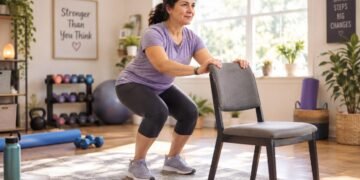























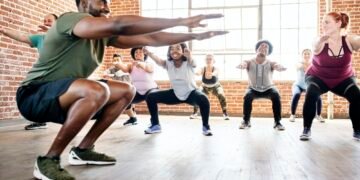












Starting with manageable resistance and a schedule you can repeat is a practical way to begin getting stronger in midlife. What might feel easier in everyday life if getting up from a chair, climbing stairs, or carrying groceries took less effort?
You can begin with bodyweight or light resistance, then build confidence before increasing the challenge. Your health, experience, mobility, and available time can shape a routine that fits your life. Gradual progress and personal adjustments will guide each choice, so your first workout does not need to look like anyone else’s.
Everyday strength goals can be simple and meaningful: stand from a low chair more easily, carry a grocery bag, or feel steadier on the stairs. The aim is not to prove how much you can lift today. It is to find a starting point you can return to, then make small changes as your ability improves.
Key Takeaways
- Start with bodyweight or light resistance that lets you move with control.
- Choose simple exercises connected to everyday tasks.
- Use a repeatable schedule, then adjust it to your needs.
- Build confidence before making an exercise harder.
- Pay attention to your comfort, ability, and recovery.
Choose a starting point that feels doable today, then build from there.
What changes in strength and function during midlife?
A gradual change in how easily you rise from a chair or climb stairs can make strength feel relevant well before older age. Function offers a practical way to notice what is changing, without treating age or appearance as a measure of ability.
Muscle mass and strength typically peak around ages 30-35 and then decline. The pace and effect of that change differ from person to person. Your activity, health, past injuries, and daily demands all shape how strength and mobility feel over time.
Muscle and strength change over time
Muscle does not suddenly disappear on a birthday. Changes tend to build gradually, and your experience may not match someone else’s. The decline in muscle power and physical performance accelerates after age 65 for women and 70 for men, but those ages are not personal deadlines.
About 30% of adults over age 70 have trouble walking, rising from a chair, or climbing stairs. That figure points to the value of noticing function early, rather than waiting for a task to become difficult. A National Institute on Aging research summary describes these age-related patterns and everyday mobility challenges.
Everyday function is a useful measure
Notice how you handle tasks that matter in your own life. Can you walk the distance you need, rise from your usual chair, manage stairs, or carry a bag without changing how you move? These observations are more useful than comparing your body with another person’s.
Use everyday tasks you want to keep doing as your measure of function, not your age or appearance alone.
You can track a task in simple terms, such as whether you use your hands to stand or pause on a flight of stairs. That gives you a personal marker to revisit as your abilities change. Use the tasks you want to keep doing as meaningful measures of function.
What can strength training support in midlife?
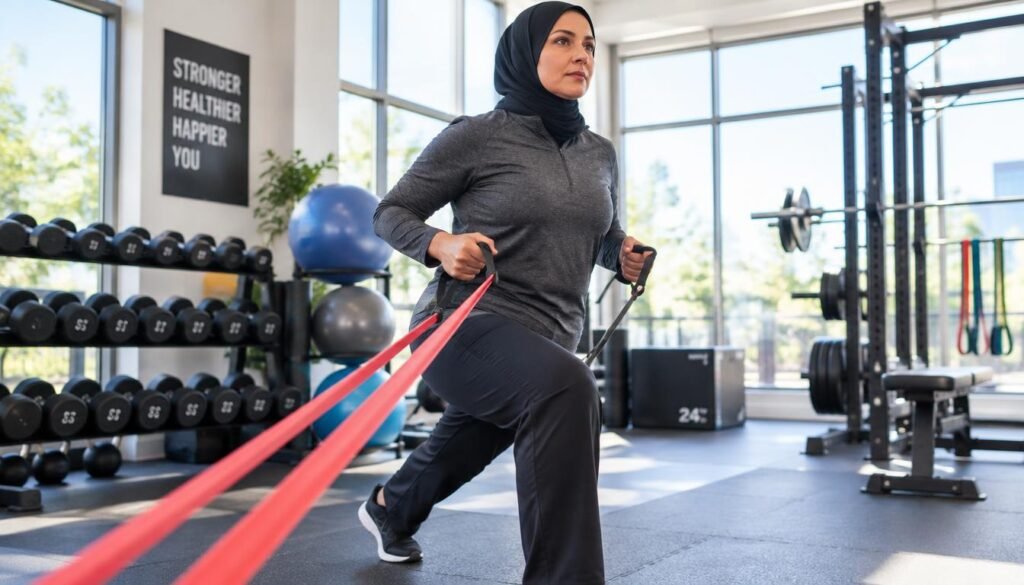
Strength training can improve several measures of muscle performance and physical function in healthy adults. Those changes can support walking, balance, and the physical work of daily movement.
Progressive resistance training is recommended to improve muscle function, size, and physical performance. In healthy adults, it improves strength, muscle size, power, endurance, contraction speed, gait speed, balance, and other function measures compared with no exercise.
Muscle strength and physical function
These measures connect to practical abilities. Stronger muscles can contribute to walking speed, balance, and control during everyday movement. A low-intensity strength and walking program can also provide substantial benefits, so training does not have to begin with heavy weights or complicated exercises.
Power is the ability to produce force quickly. Findings about power training describe specialized choices, not a starting requirement. Moderate loads of 30%-70% of one-repetition maximum, low-to-moderate volume of no more than 24 repetitions multiplied by sets, Olympic-style weightlifting, and a fast lifting phase enhanced power gains in training studies.
Those approaches ask for specific technique and planning. A new trainee can first learn controlled movements and develop a consistent habit. You do not need to copy a power program to work toward more capable movement.
Bone health and training goals
Resistance training may also support bone health, though results depend on the program and the population studied. A 2025 meta-analysis of 17 randomized controlled trials involving 690 postmenopausal women found improved bone mineral density at the lumbar spine, femoral neck, and total hip, but not the trochanter.
In that analysis, training three times per week improved bone mineral density at the lumbar spine, femoral neck, total hip, and trochanter. Study results varied substantially, which limits how broadly they apply. Training at 70% or more of one-repetition maximum improved bone mineral density at the total hip and femoral neck, while programs lasting at least 48 weeks improved it at the femoral neck and total hip.
These study details do not set a universal beginner target. Treat bone-health findings as a reason to make training sustainable, not as a promise of a particular result.
What equipment works for a beginner at home or in a gym?
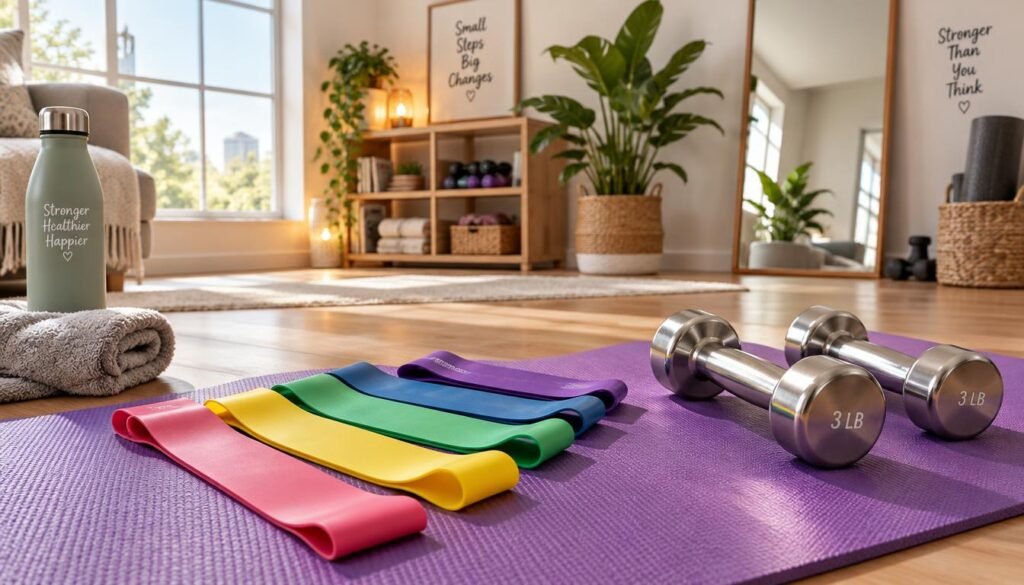
A beginner can start at home with bodyweight or a resistance band, or use dumbbells and machines in a gym. The best setup is one you can use safely and practice regularly.
You do not need a gym to add resistance. Muscle-strengthening options include resistance bands, weight machines, hand-held weights, and body-weight exercises. The table gives a practical starting example and an adjustment for each setup.
| Setup | Resistance source | Beginner examples | Useful adjustment |
|---|---|---|---|
| Bodyweight | Your body | Chair squats and wall push-ups | Use a shorter range or stable support |
| Resistance bands | Band tension | Band rows and presses | Choose lighter tension |
| Dumbbells | Hand-held weights | Light presses and rows | Pick a load for controlled movement |
| Weight machines | Adjustable machine load | Supported presses and leg exercises | Set a comfortable range |
For midlife strength training at home, bodyweight movements and a band can cover many needs without taking much space. Strength training at home without equipment can start with chair squats and wall push-ups, using the wall or chair for support.
Household items can also add resistance when they have secure handles and are easy to control. A filled water bottle may work for a light exercise; avoid objects that can slip, break, or shift unexpectedly. Keep the path clear before carrying anything through your home.
Women beginners can use the same basic equipment options as anyone else, adjusting load and movement to their ability. Weight lifting for beginners at home for women can start with light dumbbells, a band, or bodyweight, rather than a special product marketed to women. Choose the setup that makes it easiest to practice consistently.
Which movements belong in a beginner’s routine?
A 60-year-old woman can do chair squats, hip hinges, wall push-ups, supported rows, and light carries at home. These patterns cover movements used to sit, stand, lift, push, pull, and carry.
Choose a version you can control comfortably. A chair, wall, band, or light weights can make the same basic movement more manageable. The five patterns below give you options to practice without turning a beginner routine into a long exercise list.
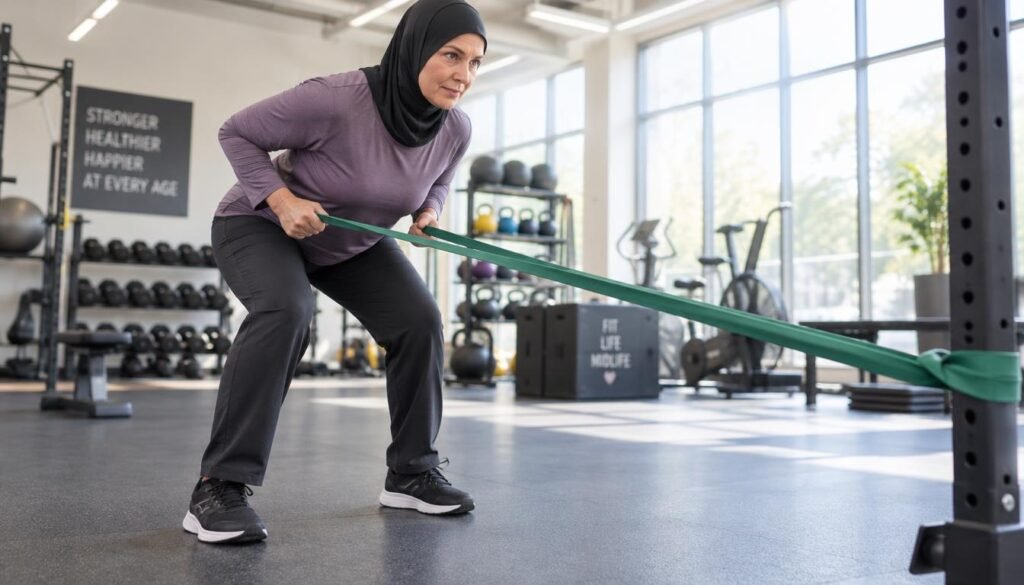
- Squat: Sit toward a chair and stand again; use the chair as a target or support.
- Hinge: Push your hips back while keeping your torso steady; practice without weight first.
- Push: Press away from a wall; move closer to the wall to make the effort easier.
- Pull: Row a band or light dumbbell toward your side; support one hand on a chair or counter.
- Carry: Hold a light object at your side and walk a short distance; begin with one small item.
A chair squat gives you a clear target and lets you choose how far to bend. For a hip hinge, imagine closing a car door with your hips while your hands rest on your thighs. Neither movement needs extra weight while you learn its shape.
A wall push-up changes the angle of the movement, while a supported row steadies your body as you pull. During a carry, use a light object that stays secure in your hand. These are home-friendly choices for a 60-year-old beginner, but the right variation is the one that fits your current ability.
Core and glute exercises can be optional additions, not requirements. Modified curl-ups, bird dogs, and side planks are core choices; glute bridges, curtsy lunges, and side lunges are other options. Start with variations you can control through a comfortable range of motion.
How to Start Midlife Strength Training Safely
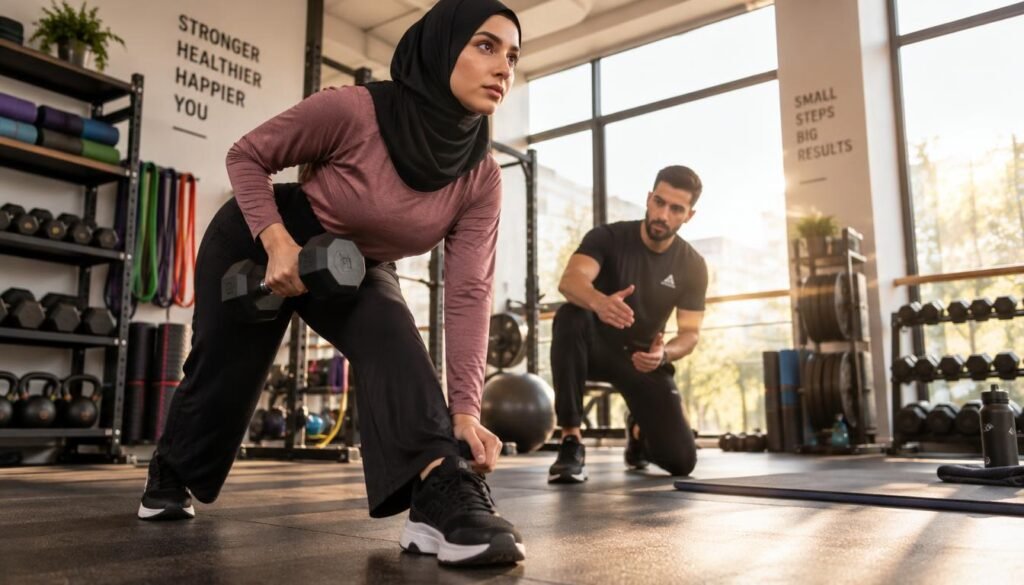
Two strength sessions each week are a solid starting target for a beginner, including a 60-year-old woman. Two days can be easier to fit into a busy week than a more ambitious workout plan.
U.S. guidelines recommend muscle-strengthening activity of moderate or greater intensity involving all major muscle groups on at least two days a week. A simple session can begin with three movements and 2-3 sets of 8-12 controlled repetitions.
| Weekly pattern | Days | Session focus |
|---|---|---|
| Two-session start | Two days | Full-body work each day |
| Three-session start | Three days | Lower-body, upper-body, and full-body sessions |
| Three-session simple format | Three days | Three key movements per session |
A beginner midlife strength training plan can use two full-body workouts per week. That meets the national muscle-strengthening recommendation when the sessions involve all major muscle groups. If three workouts feel manageable, three sessions of about 30 minutes are another workable structure.
For a midlife strength training routine, two sessions are a reasonable entry point if three feels like too much. You can spread movements across a lower-body day, an upper-body day, and a full-body day when using three sessions. The division is a planning option, not a requirement.
Some programs call three workouts per week, three key movements per session, and three sets per exercise the “3-3-3 rule.” American Heart Association activity recommendations call for muscle-strengthening activity on at least two days, not a specific 3-3-3 format.
Keep the first week simple enough to repeat. Put the sessions on days that leave room for recovery between them.
How can you progress without losing good form?
When the current version of an exercise feels controlled and easy, make one small change to challenge yourself. Progressive overload means gradually increasing the weight, repetitions, sets, range of motion, or exercise difficulty as your ability improves.
Change one training demand at a time. That makes it easier to notice whether the new version still feels controlled. More weight is only one way to make progress, and it is not always the next useful choice.
Increase one training demand at a time
Try one of these small adjustments when you are ready:
- Add a small amount of weight to the exercise.
- Add one or two repetitions while keeping the same load.
- Add a set when the current amount feels manageable.
- Improve your range of motion or control through each repetition.
One beginner recommendation is to increase dumbbells by 2.5-5 lb once 10-12 repetitions feel easy with solid form. That is a practical example, not a required jump for everyone. A smaller increase, another repetition, or a more comfortable range may suit you better.
Keep repetitions controlled
Good form means the movement stays steady and the final repetition resembles the first. You do not need to rush or swing a weight to finish a set. Stop if you cannot control the movement or keep the range you intended.
Training findings can describe goals beyond a beginner’s first steps. Strength gains were enhanced by loads of at least 80% of one-repetition maximum, a complete range of motion, 2-3 sets, and at least two weekly sessions. Those findings do not mean you should begin with high loads.
Muscle growth findings also include at least 10 sets per week and eccentric overload, which adds challenge while a muscle lengthens. That is not a starting requirement either. Build a controlled routine before considering specialized volume or loading.
The 3-3-3 format is a convenient structure for organizing workouts, not a rule for progress. Stop a set while you can still maintain control through the final repetition.
How should you adapt training to health, pain, and menopause?
Your starting load and movement range should match what your body can do comfortably today. Effort is personal, so an exercise can be useful even when you use support or a smaller movement.
Be as active as your abilities and health conditions allow. A chair-supported squat, shorter range of motion, lighter resistance, or wall push-up can help match an exercise to your current mobility.
Adjust the movement to your current ability
Choose an adjustment that makes the movement feel more manageable:
- Use support, such as a chair back or countertop.
- Shorten the range to a comfortable level.
- Reduce resistance by using a lighter weight or band.
- Choose a different movement pattern, such as a wall push-up.
Perimenopause symptoms can affect how a workout feels from day to day. If hot flashes occur, a cool, ventilated space and water may help you feel more comfortable. Not everyone experiences the same symptoms, and you can adjust your surroundings to suit your own experience.
Get individualized guidance when health conditions affect exercise
Osteoporosis, an existing injury, or another health condition may call for individualized medical or qualified exercise guidance. If you have osteoporosis, form deserves careful attention, and a qualified professional can help with unfamiliar exercises that stress the spine.
Sudden or localized weakness, neurological symptoms, or pain that limits function or persists after brief rest merits medical assessment. These signs deserve attention rather than a harder workout or a change made by guesswork.
A trainer with suitable qualifications can help adapt movements, while your health professional can account for medical needs. Seek individualized guidance before changing exercise when a health condition or injury affects safe movement.
How do recovery and other activity fit into the week?
Recovery is part of a training routine, and walking can complement strength sessions. Easy movement can help fill the week without making every day a hard workout.
Adults are advised to get 150-300 minutes of moderate-intensity aerobic activity each week, 75-150 minutes of vigorous activity, or an equivalent combination. That aerobic target is separate from the recommendation for muscle-strengthening activity.
Make recovery part of the routine
Rest between challenging sessions, sleep, hydration, and adequate nutrition all support recovery. A general sleep recommendation is 7-9 hours nightly, though your needs and sleep quality can vary. Build a bedtime routine that gives you a realistic chance to rest well.
A nutrition rule of thumb is 20-30 grams of protein per meal. Individual needs vary, and this range is not a strict target for every person. Regular meals and enough fluids can also make it easier to feel ready for daily activity.
Walking is a useful way to add aerobic activity at a manageable pace. Any amount of moderate-to-vigorous activity can provide some health benefits, and adults are advised to move more and sit less. Add walking gradually if you are starting from a mostly inactive routine.
Add aerobic and balance activity as appropriate
Adults are advised to work toward the aerobic range over the week, not to fit it all into one day. A few walks can build time gradually. Choose a pace that suits your current fitness, then add time as it becomes comfortable.
For adults aged 65 and older, balance training is also recommended alongside aerobic and muscle-strengthening activity. Walking paired with resistance training improved physical function and helped avoid disability in older adults. Balance practice should fit your ability and surroundings.
You do not need to fill every open day with exercise. Gentle movement can be useful when it leaves you feeling ready for your usual activities. Keep gentle movement on nonlifting days only when it feels comfortable and supports recovery.
Can strength training change body composition?
Weight training can help reduce body fat while supporting lean mass, but it is not a shortcut to targeted fat loss. Scale weight alone cannot show whether changes came from muscle or fat.
Resistance training can support lean mass and contribute to lower body fat, while results depend on your overall activity and nutrition. A 2022 meta-analysis of 114 trials involving 4,184 people with overweight or obesity found that resistance training alone increased lean mass by 0.8 kg compared with no-training controls.
| Training approach | Body mass and fat mass | Lean or fat-free mass | Body-fat percentage |
|---|---|---|---|
| Resistance training | Fat mass decreased 1.0 kg in trials involving people with overweight or obesity | Lean mass increased 0.8 kg in the same meta-analysis | Decreased 1.6% in the same meta-analysis |
| Aerobic training | In studies lasting at least 10 weeks, body mass and fat mass fell more than with resistance training | Resistance training retained fat-free mass better | No significant difference among aerobic, resistance, and combined training |
| Combined training | With caloric restriction, fat mass decreased 5.3 kg versus groups without intervention | Resistance training alone increased lean mass in the 2022 analysis | With caloric restriction, decreased 3.8% versus groups without intervention |
The 2022 analysis also found that resistance training alone reduced body-fat percentage by 1.6% and whole-body fat mass by 1.0 kg compared with no-training controls. When combined with caloric restriction, resistance training reduced body-fat percentage by 3.8% and whole-body fat mass by 5.3 kg compared with groups without intervention.
Those findings describe groups, not a guaranteed result for an individual. The resistance-training results involving people with overweight or obesity do not predict what will happen to your body. Food intake, activity, starting point, and consistency all matter.
In studies lasting at least 10 weeks, aerobic training reduced body mass and fat mass more than resistance training, while resistance training better retained fat-free mass. Body-fat percentage changes did not differ significantly among aerobic, resistance, and concurrent training. Track strength and everyday function alongside any changes in body weight.
Use body weight as one measure, not the whole scorecard: it cannot separate muscle changes from fat changes.
Conclusion
Getting stronger in midlife starts with a manageable routine you can return to. A repeatable start matters more than a perfect plan, especially when your schedule, health, or experience changes.
Choose movements that fit your current abilities and circumstances. You can adjust the load, range, and setup as you learn what feels controlled. A useful first workout is one you can finish comfortably and imagine doing again.
You do not need to solve every training question before beginning. Pick a simple session, notice how it feels, and make the next choice from that experience. Let progress follow your ability, rather than forcing a fixed pace.
Choose two days for your first week and begin with movements you can perform comfortably.







Discussion about this post