“Vision loss is not a normal part of aging — but vision change is. Knowing the difference may be the most important thing you do for your eyes this decade.” — National Eye Institute, NIH
The Decade That Changes Everything
Most people mark their 45th birthday with little thought about their eyes. Then, quietly, something shifts.
The restaurant menu gets harder to read. You find yourself tilting your phone to catch better light. Driving at night feels slightly less certain than it did five years ago. You chalk it up to tiredness, or stress, or simply “getting older.”
But what if those early signals are your eyes asking for something specific — and science already knows exactly what that is?
The truth is, 45 is not where eye health ends. Research now shows it is the most critical window to intervene — long before serious disease sets in. This article is not about accepting decline. It is about understanding what is biologically happening inside your eyes right now, regardless of whether you wear glasses or not, and what the evidence says you can actually do about it.
A Living Organ in a Changing Body
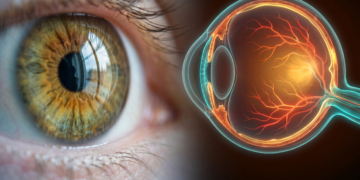
Your eyes are not static structures. They are dynamic, metabolically active organs — among the most oxygen-hungry tissues in the entire human body. After the age of 45, they undergo a series of well-documented biological shifts. None of these are opinions. All of them are measurable, and crucially, many of them are modifiable.
Here is what the science says is changing — and why it matters to you right now.
1. The Focusing System Begins to Shift — Presbyopia
The most universal vision change after 45 has a name: presbyopia. By definition, it is the gradual loss of the eye’s ability to focus on nearby objects — and it affects virtually 100% of the global population by age 50.
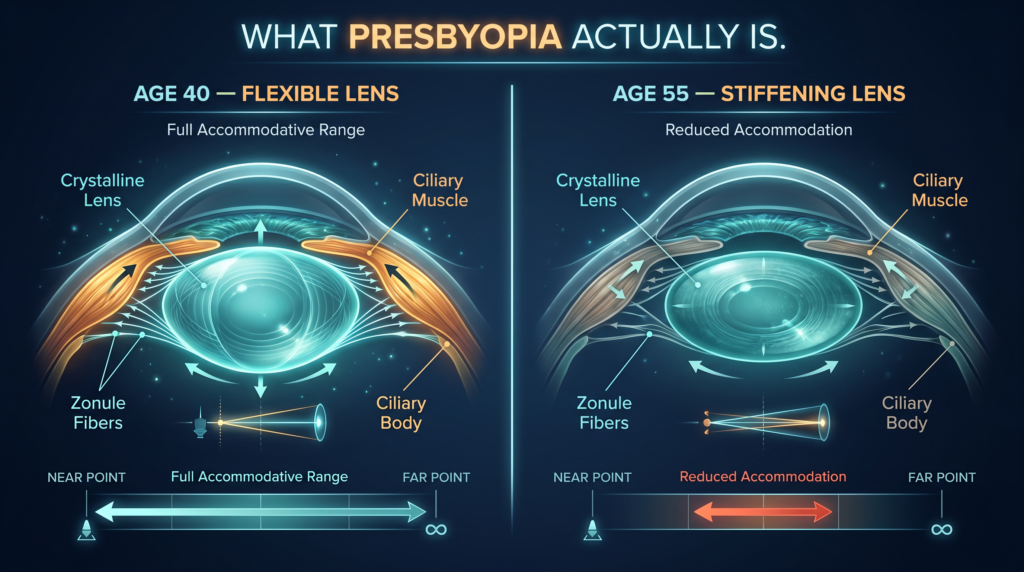
Inside your eye, a clear, flexible structure called the crystalline lens does the heavy lifting of focus. It is surrounded by a ring of smooth muscle — the ciliary muscle — that squeezes and releases to change the lens’s shape, shifting your focus from near to far thousands of times a day.
Between the ages of 40 and 55, two things happen simultaneously: the lens gradually loses elasticity and stiffens, while accommodative amplitude — the eye’s total range of focus — declines steeply. A landmark 2024 3D modeling study published in PubMed confirmed that these biomechanical changes are the primary driver of presbyopia’s progression.
What this means for you: If you are not yet using reading glasses, you will likely notice near-focus difficulty soon. If you already are, your prescription will likely stabilize in your mid-60s. This is not a catastrophe — but it is a signal that your visual system is entering a new phase that responds directly to how you care for it.
2. The Silent Pressure — Early Glaucoma Risk
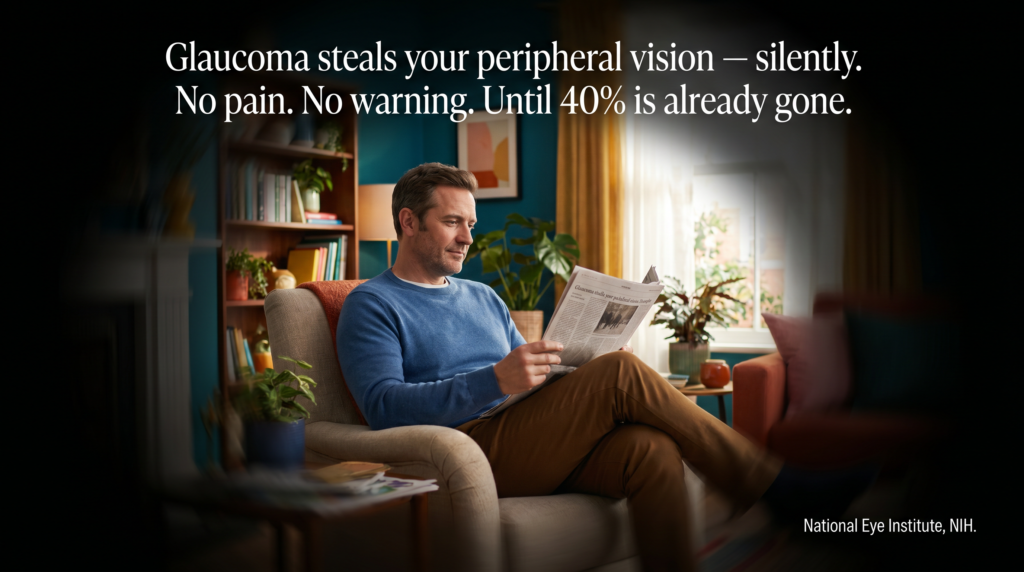
Here is the statistic that should motivate every 45-year-old: glaucoma has no symptoms in its early stages. None. It steals peripheral vision so slowly that most people lose up to 40% of their sight before they notice anything is wrong.
Glaucoma — the gradual damage of the optic nerve, most often driven by elevated intraocular pressure — becomes significantly more common after 45. The National Eye Institute identifies age as the single largest risk factor, with prevalence rising sharply from middle age onward.
The good news, buried inside that sobering fact: regular aerobic physical activity has been shown to reduce glaucoma risk by 40% or more. A study reviewed by the American Optometric Association found that meeting standard physical activity guidelines — 30 minutes of moderate exercise, three to five times per week — meaningfully reduced intraocular pressure in both healthy adults and those already diagnosed with the condition.
What this means for you: A comprehensive dilated eye exam — not just a standard vision check — after age 45 is non-negotiable. And your weekly walk or swim is not just good for your heart. It is actively protecting your optic nerve.
3. The Macula Is Being Tested Every Day
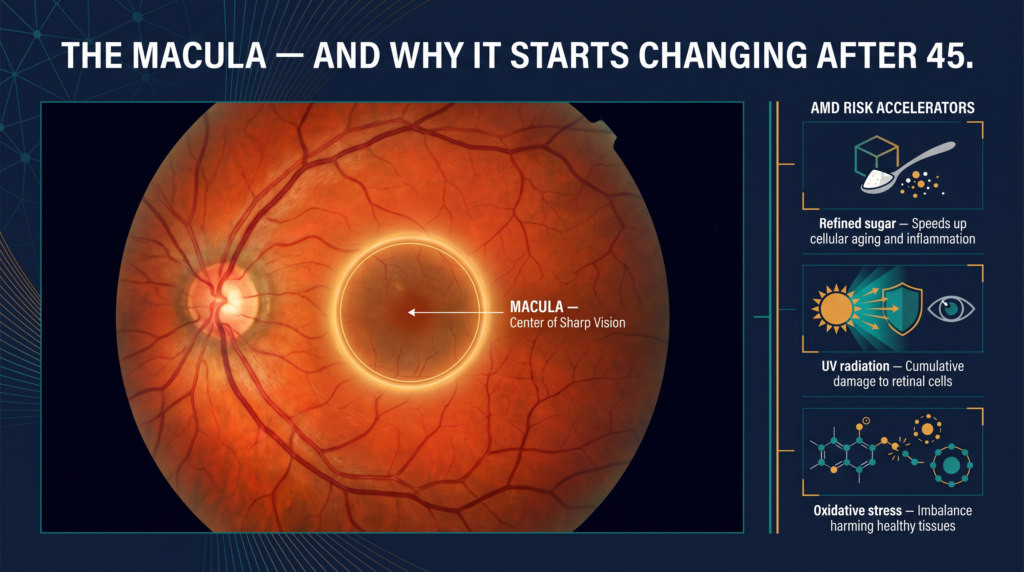
Deep at the center of your retina sits a tiny, extraordinarily specialized region called the macula — roughly the size of a sesame seed. It is responsible for 100% of your sharp, central vision: the kind you use to read, recognize faces, and drive.
Age-related macular degeneration (AMD) — the progressive deterioration of this region — is the leading cause of irreversible vision loss in adults over 50 in the developed world. It does not happen overnight. It is the cumulative result of decades of oxidative stress, chronic low-grade inflammation, poor circulation, and nutritional gaps — all of which quietly accelerate after.
A landmark NIH-funded clinical trial called AREDS2 — the Age-Related Eye Disease Study 2 — tracked thousands of patients over years and found that specific nutritional interventions can reduce the risk of AMD progressing to its advanced, sight-threatening form by approximately 25%.
The protective nutrients identified by AREDS2 include:
Lutein and zeaxanthin — carotenoids that accumulate in the macula and act as biological blue-light filters, shielding photoreceptors from oxidative damage.
Vitamin C and E — antioxidants that neutralize free radicals generated by the retina’s intense metabolic activity.
Zinc — critical for transporting Vitamin A from the liver to the retina to produce protective melanin pigment.
What this means for you: What you eat in your 40s and 50s directly shapes your macula’s resilience in your 60s and 70s. This is not speculation — it is the conclusion of one of the largest eye disease clinical trials ever conducted.
4. The Screen Problem Nobody Is Talking About Honestly
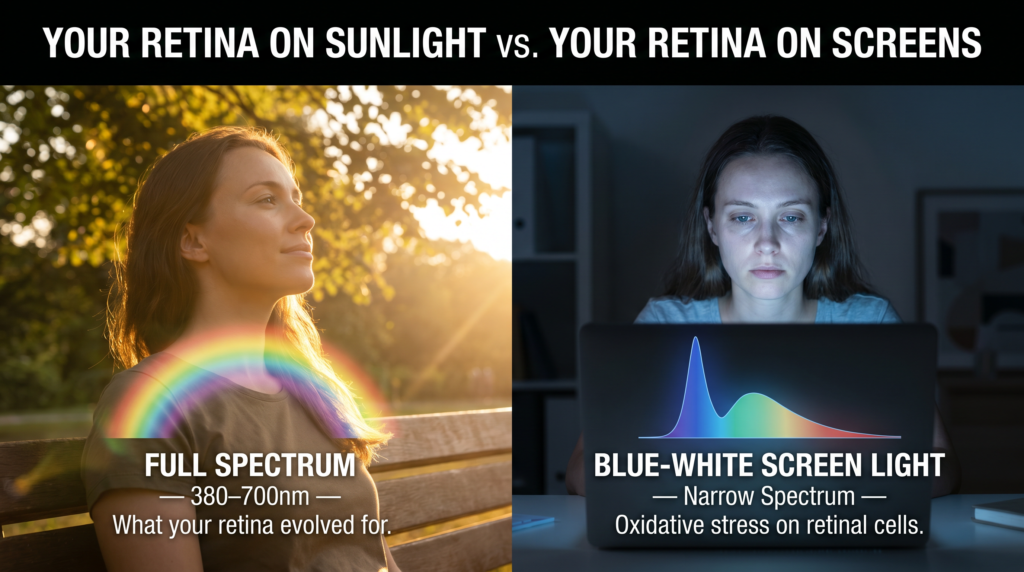
The debate around blue light and screens is often oversimplified into two camps: “screens destroy your eyes” versus “screens are completely safe.” The real picture is more nuanced — and more actionable.
A 2024 review published in Frontiers in Aging Neuroscience confirmed that prolonged blue-light exposure induces phototoxicity in retinal pigment epithelial cells — the very cells that support your photoreceptors — through mechanisms linked to oxidative stress. A separate PMC review noted that blue light toxicity affects not only the retina but also the ocular surface, triggering inflammatory responses.
What the American Academy of Ophthalmology clarifies — and this matters — is that typical screen use at current brightness levels does not deliver blue light at doses shown to cause retinal damage in healthy adults. The more immediate and proven concern is digital eye strain: the fatigue, dryness, blurred vision, and headaches that result from reduced blink rate (dropping from 15–20 blinks per minute to as few as 5 during screen time) and sustained near focus.
After 45, when the eye’s focusing system is already under natural strain, digital eye strain compounds existing presbyopia symptoms significantly.
What this means for you: The 20-20-20 rule — every 20 minutes, look at something 20 feet away for 20 seconds — is evidence-supported for reducing eye strain.
Combine it with conscious blinking and screen brightness calibrated to your ambient light, and you remove a real daily stressor from your visual system.
5. Floaters, Dry Eyes, and the Changes Nobody Warns You About
Beyond the headline conditions, two changes affect the majority of adults after 45 and are frequently dismissed as minor inconveniences:
Vitreous floaters — those drifting specks, threads, or cobwebs in your field of vision — become increasingly common as the vitreous gel that fills the eye liquefies and shrinks with age.
54. For most people, they are harmless. However, a sudden dramatic increase in floaters, especially accompanied by flashing lights or a dark curtain effect, is a medical emergency requiring immediate evaluation for retinal detachment.
Dry eye syndrome becomes significantly more prevalent after 45, particularly in women following hormonal shifts. The tear film thins, blink quality decreases, and screen time exacerbates both factors. Emerging research, including a 2024 PubMed study, found a meaningful correlation between dry eye severity and retinal thickness changes in middle-aged adults — suggesting it is not merely a comfort issue but a genuine indicator of broader ocular health.
The Evidence-Based Protection Plan — For Everyone
Whether you have perfect vision, wear reading glasses, or depend on corrective lenses full-time, the following approaches are backed by peer-reviewed research and recommended by leading eye health institutions.
🥗 Eat for Your Macula
The AREDS2 trial was definitive: your nutritional choices directly influence long-term retinal health. Here is how to translate that into your daily plate:
Eat More Of
Why
Best Sources
Lutein & Zeaxanthin
Accumulate in macula, filter harmful blue light
Egg yolks, cooked kale, cooked spinach with olive oil
Omega-3 fatty acids (DHA/EPA)
Structural fat of the retina; anti-inflammatory
Wild salmon, sardines, mackerel (2x/week)
Vitamin C
Neutralizes retinal oxidative stress
Bell peppers, citrus, strawberries
Zinc
Enables Vitamin A transport to the retina
Pumpkin seeds, oysters, beef
Vitamin E
Protects cell membranes from oxidative damage
Almonds, sunflower seeds, avocado
Reduce: Refined sugars (which damage retinal microvessels through glycation over time, ultra-processed seed oils high in pro-inflammatory omega-6 fats, and alcohol — all of which accelerate oxidative load in the retina.
🏃 Move Your Body — It Protects Your Eyes
This is perhaps the most underappreciated finding in modern eye health research. A comprehensive 2024 PMC review confirmed that regular physical exercise exerts measurable protective effects across multiple eye conditions — including AMD, glaucoma, diabetic retinopathy, and cataract formation — through improved ocular blood flow, reduced oxidative stress, and lower systemic inflammation.
Specifically:
Walking briskly for 30 minutes, 3–5 days per week, can reduce intraocular pressure and glaucoma risk by up to 40%.
Endurance training has been shown to slow lens aging by reducing inflammation — lowering cataract risk.
Moderate aerobic exercise appears to suppress the abnormal blood vessel growth linked to advanced AMD.
You do not need a gym. You need consistency.
🌞 Respect the Sun — Don’t Fear It
UV radiation is a proven accelerant of both cataracts and AMD. Yet natural daylight — filtered appropriately — is equally important for circadian rhythm regulation, dopamine signaling in the retina, and overall ocular health.
The evidence-based approach is simple: wear UV-blocking sunglasses outdoors (look for 100% UVA/UVB protection), but do not avoid daylight entirely. Aim for 20–30 minutes of outdoor light exposure daily, ideally in the morning — this supports retinal dopamine pathways and helps regulate intraocular pressure naturally..
👁️ Practice Conscious Visual Rest
Especially relevant for those who spend significant time on screens or close-up work, intentional visual rest is supported by optometric research:
20-20-20 rule every 20 minutes during screen use
Conscious blinking — set a reminder if needed; blink fully and slowly to refresh the tear film
Warm compress on closed eyes for 2 minutes in the evening — clinically shown to improve meibomian gland function (the glands responsible for the oily layer of your tear film), reducing dry eye symptoms
Reduce overhead fluorescent lighting where possible in favor of warm, indirect lighting during close work
🩺 Schedule a Comprehensive Dilated Eye Exam — Now
This is the single most important item on this list. The NIH and the American Academy of Ophthalmology both recommend that adults begin comprehensive dilated eye exams — not just standard vision screenings — starting at age 40, repeated every one to two years thereafter.
A dilated exam allows the ophthalmologist to examine the optic nerve, retina, macula, and blood vessels — structures that standard screenings entirely miss. Early-stage AMD, glaucoma, and diabetic retinopathy are all detectable — and all treatable — when caught early. They are devastating when caught late.
When to Stop Reading and Call a Doctor Today
Not all vision changes are gradual. The following symptoms are medical emergencies that require immediate attention — not next week, today:
⚡ Sudden vision loss in one or both eyes, even briefly
🌩️ New flashes of light at the edges of your vision
🦟 A sudden shower of new floaters — especially with flashing
🌑 A dark curtain or shadow falling across part of your visual field
🔴 Severe eye pain combined with nausea and halos around lights
These are not symptoms of routine aging. They are potential signals of retinal detachment, acute glaucoma, or vascular occlusion — all of which are time-sensitive emergencies.
The Bottom Line
Vision after 45 is not a one-way street toward decline. It is a biological turning point — one where the choices you make about food, movement, light, sleep, and regular care create a measurable divergence in outcomes over the following decades.
The research is unambiguous: the eyes that age best belong to people who treat them as the living, metabolically demanding organs they are — not as passive instruments that simply need stronger lenses every two years.
You have more agency over your vision than you have probably been told. Use it.
⚠️ Medical Disclaimer:This article is intended for educational and informational purposes only. It does not constitute medical advice, diagnosis, or treatment. Always consult a qualified eye care professional — an ophthalmologist or optometrist — regarding your specific vision needs, symptoms, and any changes in your eyesight. If you experience sudden vision changes, seek emergency medical care immediately.
📚 Sources & References: National Eye Institute (NIH) | PubMed Central | AREDS2 Clinical Trial (JAMA, 2013; NEI, 2022) | American Academy of Ophthalmology | Frontiers in Medicine — Presbyopia 2022 | Frontiers in Aging Neuroscience 2024 | PMC — Oxidative Stress and the Aging Eye 2023 | PMC — Effects of Exercise on Ocular Disease 2024 | Cleveland Clinic | American Optometric Association






































Discussion about this post