
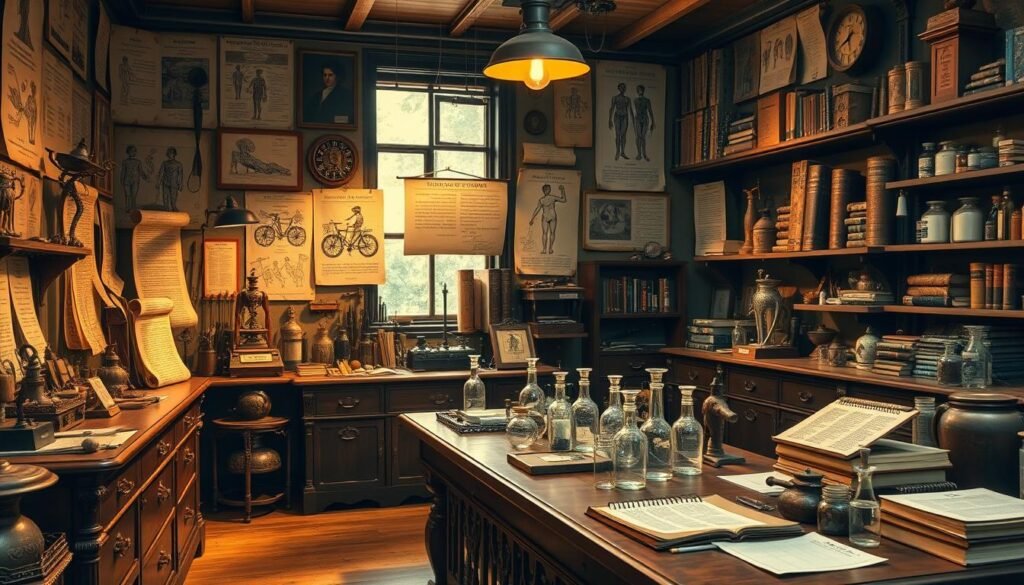
Get ready to explore the amazing world of medical history! From ancient times to today, healthcare has seen incredible changes. We’ll share seven fun facts that will amaze and teach you a lot. You’ll learn about the origins of major medical discoveries and the pioneers who made them possible.
Key Takeaways
- Uncover the surprising origins of groundbreaking medical advancements
- Discover the remarkable pioneers who revolutionized healthcare
- Explore the fascinating evolution of ancient medical practices
- Learn about bizarre historical remedies and their surprising impacts
- Delve into the captivating stories behind accidental medical breakthroughs
The Fascinating Journey Through Medical History
From ancient times to today, the history of medicine is a thrilling story. It shows how early ideas have shaped today’s healthcare. This journey reveals the impact of ancient traditions on modern medicine.
Ancient Medical Practices That Shaped Modern Medicine
The roots of today’s medicine go back to ancient times. Egyptians, Greeks, and Chinese made big contributions. They started treatments, created medical theories, and recorded their findings.
This laid the groundwork for healthcare’s growth over the centuries.
Evolution of Healthcare Through Centuries
- In the Middle Ages, hospitals and specialized doctors like surgeons and apothecaries became common.
- The Renaissance brought a new understanding of the body, thanks to Leonardo da Vinci and Andreas Vesalius.
- The 19th century saw big leaps in understanding germs, anesthesia, and cleanliness in medicine.
- The 20th century introduced new medicines, antibiotics, and imaging technologies, changing disease diagnosis and treatment.
Looking at the evolution of medical practices, we find bizarre historical remedies and peculiar medical beliefs. This journey shows human resilience and creativity in fighting disease and improving life.

| Era | Key Medical Advancements |
|---|---|
| Ancient Civilizations | Pioneered treatments, developed medical theories, and documented discoveries |
| Middle Ages | Rise of hospitals and specialized medical professionals |
| Renaissance | Groundbreaking work in anatomy and understanding the human body |
| 19th Century | Advancements in germ theory, anesthesia, and antiseptic practices |
| 20th Century | Development of modern pharmaceuticals, antibiotics, and medical imaging technologies |
“The art of medicine consists of amusing the patient while nature cures the disease.” – Voltaire
Medical History Fun Facts That Changed Healthcare Forever
The history of medicine is full of amazing stories. These stories show how new discoveries changed healthcare forever. They include accidental finds and big breakthroughs that have saved many lives and changed how we care for patients.
A big moment was when Alexander Fleming found penicillin in 1928. He was studying bacteria when he saw mold kill them. This led to the first antibiotic, a key part of modern medicine.
Another key moment was when Sir Frederick Banting and Charles Best found insulin in 1922. This discovery changed diabetes treatment. It let patients with diabetes live longer, healthier lives.
- The accidental discovery of X-rays by Wilhelm Röntgen in 1895, which revolutionized medical imaging and diagnostics.
- The development of the first successful polio vaccine by Jonas Salk in 1955, which eradicated a devastating disease that had plagued humanity for centuries.
- The groundbreaking work of Marie Curie, whose research on radioactivity led to advancements in cancer treatment and diagnosis.
These stories show the power of curiosity and hard work in science. Each of these moments has made a big difference in healthcare. They show us the potential for even more important discoveries in the future.
“The greater the obstacle, the more glory in overcoming it.” – Molière

Bizarre Historical Remedies and Their Surprising Origins
Medical history is filled with strange practices and treatments that make us laugh today. The journey of healthcare has been both fascinating and amusing.
Strange Ingredients in Medieval Medicine
In the Middle Ages, medicine was very different. Doctors used weird ingredients for their remedies. Bizarre historical remedies included mummy powder and crushed gemstones, believed to have magical healing powers.
- Mummy powder was thought to treat many ailments, like headaches and open wounds.
- Powdered pearls were used for mental disorders and to improve eyesight.
- Bezoar stones, found in animals’ digestive tracts, were used as poison antidotes.
Popular Treatments That Would Shock Modern Doctors
Some old medical beliefs are shocking today. Treatments like bloodletting, trepanation, and using leeches were once common.

Cultural Influences on Historical Healing Methods
Different cultures and beliefs have shaped medical history. From traditional Chinese medicine to shamanic rituals, healthcare has changed a lot. It shows the values and worldviews of past societies.
“The art of medicine consists of amusing the patient while nature cures the disease.” – Voltaire
Exploring medical history reveals a world of bizarre historical remedies, peculiar medical beliefs, and amusing medical anecdotes. These stories continue to fascinate and inspire us.
Legendary Physicians Who Revolutionized Medicine
The history of medicine is filled with the remarkable contributions of fascinating medical pioneers and legendary physicians. These individuals dedicated their lives to advancing healthcare. They pushed the boundaries of scientific understanding and introduced groundbreaking innovations.
One such pioneering figure is Sir Alexander Fleming, the Scottish bacteriologist. He discovered the world’s first antibiotic, penicillin, in 1928. Fleming’s discovery revolutionized the treatment of bacterial infections and saved millions of lives.
Marie Curie, the Polish-born physicist and chemist, is another medical giant. Her work on radioactivity led to the development of radium as a cancer treatment. This breakthrough earned her two Nobel Prizes and solidified her legacy.
“Nothing in life is to be feared, it is only to be understood. Now is the time to understand more, so that we may fear less.” – Marie Curie
These are just a few examples of the fascinating medical pioneers who have left a lasting impact on healthcare. Their contributions and innovative approaches continue to inspire the next generation of medical professionals. They strive to push the boundaries of what’s possible in the pursuit of better health for all.

Groundbreaking Discoveries That Saved Millions
History is full of medical discoveries and innovations that changed healthcare. These breakthroughs saved millions of lives. They came from both chance and intentional efforts in medical science.
Accidental Medical Breakthroughs
Some of the biggest medical wins were by accident. For example, Alexander Fleming found penicillin by mistake in 1928. This changed how we treat bacterial infections. It started the era of antibiotics.
Wilhelm Röntgen discovered X-rays in 1895 by accident. This discovery changed how doctors diagnose diseases. It let them see inside the body for the first time.
Revolutionary Moments in Medical Science
There have also been many intentional discoveries that changed health worldwide. Jonas Salk created the first polio vaccine in 1955. This greatly reduced polio cases.
Marie Curie worked on radioactivity, helping in cancer treatments and diagnosis. Her work was a big step forward in medicine.
“The art of medicine consists of amusing the patient while nature cures the disease.” – Voltaire
These discoveries, whether by chance or plan, have greatly improved healthcare. They have saved millions and made life better for many. By learning about these breakthroughs, we see how far medicine has come.
Amusing Medical Instruments from the Past
Exploring the history of medicine, we find many funny medical tools. These tools show how our ancestors were creative in trying to help people feel better. They used these tools to improve health.
These medical tools range from strange to hilarious. They show how fast medicine has grown. Let’s look at some funny examples and how they helped create today’s medical tools.
Leeching Devices: A Bloody Affair
Leeches were once used to “purify the blood” in the 19th century. They were applied in large numbers to patients, sometimes causing more problems. The devices used to hold leeches are interesting examples of how medicine has changed.
Trepanation: Drilling into the Past
In ancient times, trepanation was used to drill holes in skulls. It was meant to help with health issues. The old tools, like hand-cranked drills, seem amusing today. Medicine has made huge progress since then.
| Instrument | Purpose | Modern Equivalent |
|---|---|---|
| Bloodletting Lancet | Letting blood to “purify” the body | Needle or Syringe |
| Trepanation Drill | Drilling into the skull to relieve pressure | Precision Power Drill |
| Mercury Thermometer | Measuring body temperature | Digital Thermometer |
From leeching devices to trepanation tools, these old medical tools are fascinating. They show the amazing growth of medicine and our ancestors’ creativity. Looking back, we see how far healthcare has come and the ongoing progress in medicine.
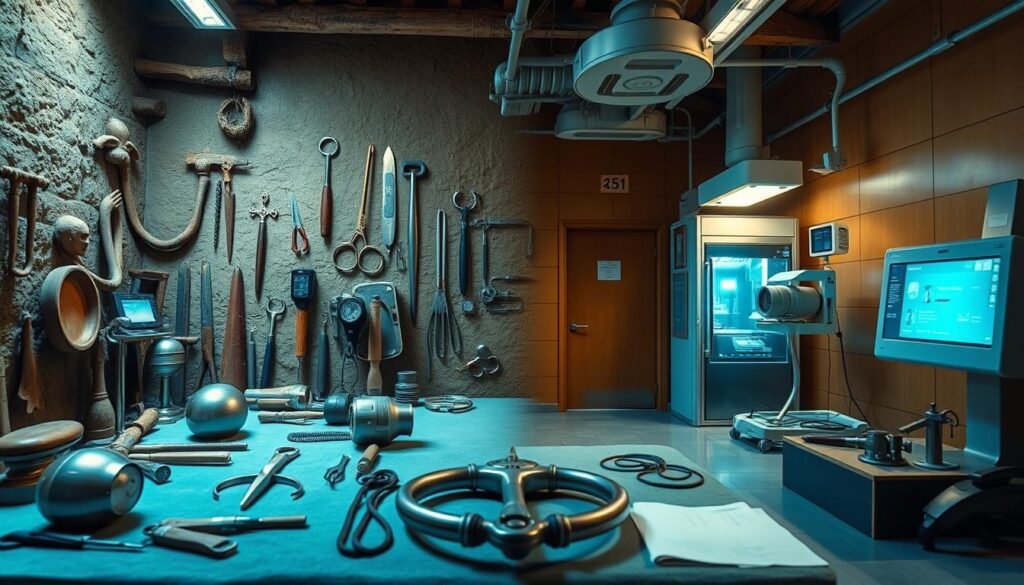
Ancient Surgical Techniques and Their Modern Equivalents
The journey of medical practices is fascinating. It shows the creativity and determination of medical pioneers. From old surgical methods to today’s advanced procedures, healthcare has made huge strides.
Evolution of Surgical Tools
Surgical tools have evolved a lot since ancient times. Back then, doctors used simple tools like knives and saws. These tools were basic and not as precise as today’s.
Now, surgeons use many specialized tools. These include scalpels, sutures, and even robotic arms. These tools help make surgeries more precise and less invasive. This has greatly improved patient care and recovery times.
From Primitive to Present-Day Procedures
- In ancient Egypt, surgeons used basic techniques like trepanation, where they would drill holes in the skull to relieve pressure or remove damaged bone.
- The ancient Greeks developed more sophisticated procedures, such as the removal of cataracts and the treatment of hernias.
- During the Middle Ages, Arabic physicians made significant advancements, including the use of anesthesia and the development of specialized instruments for operations.
- In the 19th century, the introduction of antiseptic techniques and anesthesia revolutionized surgical practices, leading to a dramatic increase in successful operations.
- Today, modern surgical techniques, such as laparoscopic and robotic-assisted surgery, allow for minimally invasive procedures that reduce patient discomfort and recovery time.
| Ancient Surgical Techniques | Modern Equivalents |
|---|---|
| Trepanation | Craniotomy |
| Cataract removal using a sharp instrument | Phacoemulsification cataract surgery |
| Hernia repair using sutures and bandages | Laparoscopic hernia repair |
| Amputation using a saw and cauterization | Minimally invasive amputation with advanced prosthetics |
The evolution of medical practices is a captivating journey. The fascinating medical pioneers who have pushed the boundaries of surgical science have played a crucial role in shaping today’s healthcare.

Peculiar Medical Beliefs Throughout History
Medical history is filled with strange beliefs and odd remedies. These ideas, based on myths and limited science, have shaped healthcare in interesting ways. They show how far we’ve come in understanding health.
In ancient Egypt, cat mummies were thought to heal. Medieval Europe believed bloodletting could fix almost any problem. These beliefs have greatly influenced modern medicine. Exploring these ideas helps us see how far healthcare has advanced.
The Enduring Appeal of Bizarre Historical Remedies
People still find fascination in old remedies like using leeches or powdered unicorn horn. These peculiar medical beliefs came from a wish to solve health issues simply. They seem odd today but were once widely accepted.
- Bloodletting: A practice for centuries, based on removing “bad” blood to cure ailments.
- Trepanation: Drilling holes in the skull to release “evil spirits” and treat various conditions.
- Urine therapy: Drinking or applying one’s own urine was believed to have healing properties.
As science grew, these peculiar medical beliefs and bizarre historical remedies were proven wrong. They were replaced by treatments backed by evidence.

“The history of medicine is full of strange beliefs and practices that we now consider bizarre or even dangerous. But understanding these peculiar medical beliefs can help us appreciate how far the field of healthcare has progressed.”
Looking back, we see the evolution of medical thought. From ancient times to today, medical science has made huge strides. By studying these bizarre historical remedies, we value the journey of medical science.
| Peculiar Medical Belief | Historical Context | Modern Perspective |
|---|---|---|
| Bloodletting | Widely practiced for centuries to “balance the humors” | Debunked as an ineffective and potentially harmful practice |
| Trepanation | Ancient practice to release “evil spirits” and treat various conditions | Recognized as a risky and unjustified surgical procedure |
| Urine Therapy | Believed to have curative properties in some traditional medical systems | Considered a pseudoscientific and unproven remedy |
Historical Pandemics and Their Impact on Medical Innovation
Medical history is filled with stories of pandemics that changed medicine forever. These crises pushed the field forward with new research, solutions, and health measures. They led to big steps forward in fighting diseases.
Humanity has faced many pandemics, each marking medicine’s growth. From the 14th century’s plague to COVID-19, these crises drove scientists and health workers to innovate. They worked hard to understand and stop infectious diseases.
Pandemics have sparked major medical breakthroughs. Vaccines, better tests, and health plans all came from past lessons. These stories show medicine’s strength and creativity in the face of big challenges.
Looking back at medical history teaches us a lot. It shows us how far we’ve come and the importance of medical progress. This progress helps keep communities safe and healthy worldwide.
| Pandemic | Year(s) | Major Medical Innovations |
|---|---|---|
| Bubonic Plague | 1346-1353 | Advancements in quarantine protocols, development of early public health measures |
| Smallpox | 1520s-1980 | Invention of the smallpox vaccine, improvements in disease surveillance and outbreak response |
| Spanish Flu | 1918-1920 | Increased research into infectious diseases, advancements in respiratory care and epidemiology |
| HIV/AIDS | 1981-present | Breakthroughs in antiretroviral therapy, advancements in understanding of viral infections |
| COVID-19 | 2019-present | Rapid development of mRNA vaccines, advancements in telemedicine and remote healthcare delivery |
The captivating tales from the annals of medicine and the evolution of medical practices show medicine’s strength. By learning from past pandemics, we see how far we’ve come. We also see the key role of innovation in keeping us healthy.
“The greatest threat to humanity is the belief that someone else will save us.”
Medical Myths That Were Once Considered Facts
History shows us many medical beliefs that were once thought to be true but are now known to be false. These old ideas, once seen as science, show how healthcare keeps changing. They highlight the ongoing quest for better medical knowledge.
Debunked Theories That Changed Medicine
The idea of the four humors – blood, phlegm, yellow bile, and black bile – is a great example. This idea from ancient Greece said that being out of balance was the cause of all sickness. Doctors used bloodletting to fix this balance, but it’s now seen as harmful.
Historical Misconceptions in Healthcare
For a long time, people thought diseases came from “bad air.” This idea lasted until Louis Pasteur and Robert Koch proved germs cause disease. This old thinking slowed down the start of important sanitation and understanding how diseases spread.
As medicine keeps growing, it’s key to question old beliefs and welcome new science. By fighting off old medical myths, doctors can lead to better, science-backed care. This will help patients and shape medicine’s future.