
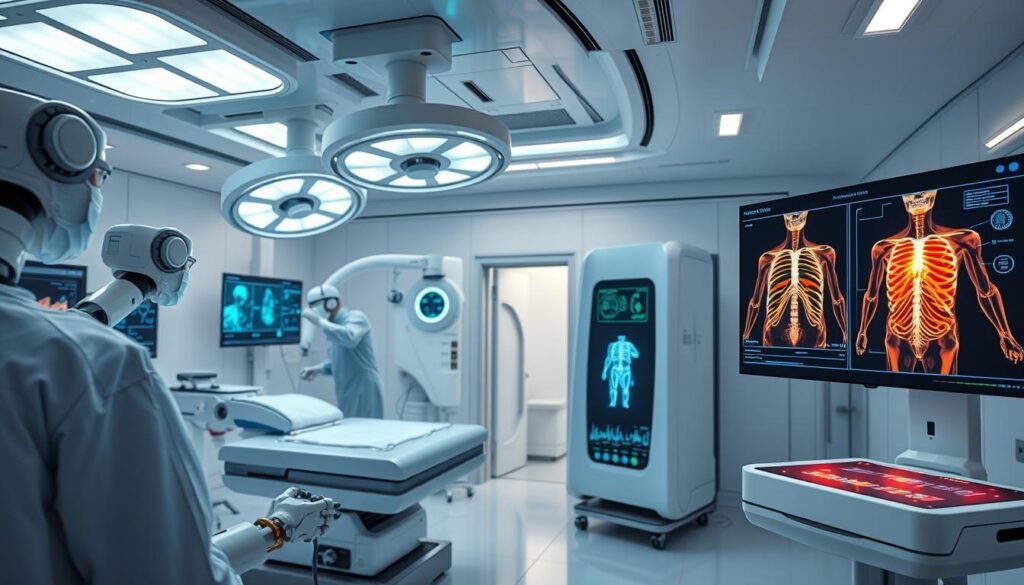
The world of medicine is changing fast thanks to artificial intelligence. Medical AI technology is making doctors better at diagnosing and treating patients. This is opening up new ways to make care more precise and efficient.
Advanced algorithms and machine learning are helping doctors make smarter choices. They can spot diseases sooner and tailor treatments to each patient. Medical AI is also improving traditional healthcare methods.
AI in healthcare is more than just processing data. It’s changing how doctors care for patients, conduct research, and find new treatments.
Key Takeaways
- AI is revolutionizing diagnostic accuracy and speed
- Machine learning enables personalized patient treatments
- Medical AI technology reduces human error in healthcare
- Advanced algorithms support complex medical research
- Healthcare professionals are increasingly integrating AI tools
Understanding AI in Healthcare
Artificial Intelligence is changing healthcare in big ways. It helps doctors diagnose and treat patients better. Machine learning lets computers understand and act on medical data.
AI can handle lots of information fast and right. Deep learning makes algorithms smarter. They can spot patterns in medical images and records.
What Defines AI in Healthcare?
AI in healthcare is about making doctors better, not replacing them. These systems can:
- Analyze medical images with remarkable precision
- Predict possible health risks
- Offer treatment plans tailored to each patient
- Make medical office work easier
Key Components of AI Technology
AI in medicine relies on a few key parts:
| Technology | Primary Function | Healthcare Application |
|---|---|---|
| Machine Learning | Pattern Recognition | Diagnostic Image Analysis |
| Deep Learning | Complex Data Processing | Predictive Health Modeling |
| Neural Networks | Adaptive Learning | Treatment Recommendation |
“AI is not about replacing human intelligence, but augmenting it in healthcare.” – Dr. Eric Topol, Digital Medicine Researcher
As tech gets better, AI in healthcare keeps improving. It offers new ways to tackle medical problems. Deep learning makes diagnoses faster and more accurate, tailored to each patient.
The Benefits of AI in Medical Diagnostics
Medical diagnostics are changing fast thanks to artificial intelligence. AI is making it easier for doctors to find and understand medical problems. This leads to better and faster care for patients.
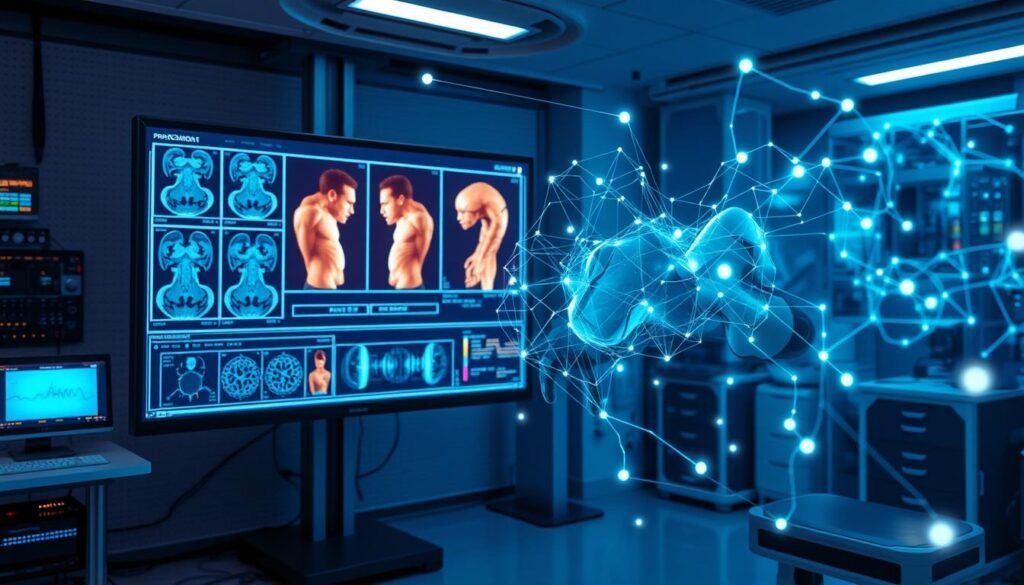
AI in medical images is a big step forward. These smart systems can look at complex images and spot health issues that humans might miss.
Enhanced Accuracy in Disease Detection
AI brings big benefits to medical diagnostics:
- It finds tiny problems in scans
- It cuts down on mistakes made by humans
- It analyzes images quickly and consistently
“AI is not replacing doctors, but empowering them with advanced diagnostic tools” – Dr. Eric Topol, Digital Medicine Researcher
Speeding Up Diagnostic Processes
AI makes medical checks much faster. Old ways of checking for health issues took a lot of time. But AI can look at scans in just minutes, helping doctors make quicker decisions.
Fast diagnostic processes bring many benefits:
- Quick first checks
- Focus on urgent cases
- Less time for patients to wait
AI in medical diagnostics is a huge leap forward. It promises more accurate, efficient, and tailored care for everyone.
AI and Personalized Medicine
The healthcare world is changing fast with personalized medicine AI. This new method uses advanced tech to make treatments just for each patient. It’s a big step away from the old “one size fits all” approach.
Predictive healthcare analytics are changing how doctors treat patients. They look at genetic, lifestyle, and medical history data. AI systems use this info to give very accurate health insights.
Tailoring Treatments to Individual Patients
AI-driven personalized medicine lets doctors make plans just for you. They look at:
- Genetic predispositions
- Individual metabolic responses
- Potential medication interactions
- Personal health risk factors
“AI transforms medical treatment from reactive to proactive, creating a future where prevention is as important as cure.” – Medical Innovation Research Center
The Role of Data in Personalization
Predictive healthcare analytics use big data to find patterns humans can’t see. Machine learning algorithms go through millions of patient records. They find insights that help predict health risks and suggest ways to prevent them.
Personalized medicine AI is a major step forward in healthcare. It promises treatments that are more effective, precise, and focused on the patient.
AI in Patient Monitoring and Management
The healthcare world is changing fast thanks to AI health monitoring. Now, patients are more involved in their health care than ever before.
Predictive patient care is a big step forward. It helps spot health risks early. AI systems collect and analyze lots of patient data in real-time. This gives doctors a deep look into each patient’s health.
Continuous Health Tracking Innovations
- Wearable devices that monitor vital signs
- Smart sensors tracking complete health metrics
- Machine learning algorithms spotting small health changes
- Remote patient monitoring platforms
Predictive Analytics in Healthcare
AI predictive analytics help doctors predict health issues with great accuracy. These advanced systems can:
- Spot early signs of chronic diseases
- Offer personalized ways to prevent problems
- Lower hospital readmission rates
- Improve treatment plans
“AI is changing patient care from reactive to proactive healthcare” – Dr. Emily Rodriguez, Digital Health Innovator
| AI Monitoring Technology | Key Benefits | Patient Impact |
|---|---|---|
| Continuous Blood Glucose Monitoring | Real-time tracking | Immediate action |
| Heart Rate Variability Analysis | Checks stress and heart risk | Helps manage health |
| Sleep Pattern Monitoring | Gives full health insights | Offers tailored wellness tips |
As AI health monitoring gets better, patients will get more advanced and tailored care. This care will focus on preventing problems and improving overall health.
Transforming Drug Discovery with AI
The pharmaceutical industry is on the verge of a big change, thanks to artificial intelligence. AI is changing how we make life-saving medicines. It makes it faster and cheaper to get new treatments to people.
Researchers use advanced AI algorithms to speed up drug development. Before, finding a new drug could take decades and cost billions. Now, AI makes this process much quicker and cheaper.
Accelerating Research and Development
AI is making big changes in pharmaceutical research. It does this in several ways:
- Rapid molecular screening of possible drug compounds
- Predictive modeling of drug interactions
- Finding therapeutic targets faster
- Less need for trial and error
“AI is not replacing researchers, but empowering them to make more informed decisions more quickly.” – Dr. Elena Rodriguez, Pharmaceutical Research Institute
AI’s Role in Clinical Trials
AI is also changing clinical trials. It helps with finding patients, analyzing data, and predicting outcomes. Machine learning algorithms can:
- Find the best patients for trials
- Predict side effects
- Watch how patients respond in real-time
- Make trials shorter and cheaper
The use of AI in drug discovery is a huge step forward for medical innovation. It promises faster, more precise, and possibly more effective treatments for serious diseases.
AI in Administrative Tasks
Healthcare automation is changing how hospitals work behind the scenes. It’s making hospital management more efficient. AI is bringing new levels of productivity to medical institutions.

Healthcare today faces a big challenge with too many administrative tasks. These tasks take up a lot of time and resources. But, AI is here to help make these tasks easier.
Streamlining Hospital Operations
AI is changing how hospitals manage their work. It’s making things smarter and more efficient:
- Automated patient scheduling
- Intelligent resource allocation
- Real-time inventory management
- Predictive maintenance for medical equipment
“AI is not replacing healthcare workers, but enabling them to work smarter and more efficiently.” – Healthcare Technology Experts
Reducing Administrative Burdens
AI systems are making a big difference in healthcare. They help doctors and nurses spend more time on patient care. This means less time on paperwork.
Healthcare automation brings many benefits:
- Reduced human error
- Faster processing of patient information
- Lower operational costs
- Enhanced data accuracy
The future of healthcare management is all about using AI to improve patient care and administrative tasks.
Challenges of Implementing AI in Healthcare
Introducing artificial intelligence in healthcare comes with big hurdles. AI has the power to change healthcare, but there are many challenges. These include keeping patient data safe and dealing with AI issues.
Healthcare systems face many obstacles when they try to use new tech. These problems need careful planning and a deep understanding.
Data Privacy and Security Concerns
Patient data is very sensitive. AI systems must protect it well to avoid breaches.
- Strict encryption protocols
- Advanced cybersecurity measures
- Comprehensive patient consent frameworks
- Rigorous compliance with HIPAA regulations
“The future of healthcare AI depends on maintaining patient trust through exceptional data protection strategies.” – Healthcare Technology Expert
Overcoming Resistance to Change
Healthcare workers often doubt new tech. To succeed with AI, you need to educate them well and show its value.
| Challenge | Mitigation Strategy |
|---|---|
| Professional Skepticism | Targeted Training Programs |
| Technical Understanding | Interactive Workshops |
| Performance Concerns | Transparent Performance Metrics |
Using teamwork, ongoing learning, and clear talks can help solve AI problems in healthcare.
The Future of AI in Healthcare
The world of medical technology is changing fast. The future of medical AI looks to bring big changes in how we care for patients and deliver healthcare. New technologies are leading to a time of great innovation in medicine.

- Advanced diagnostic algorithms that can detect diseases with superhuman precision
- Personalized treatment plans driven by complex machine learning models
- Real-time patient monitoring using predictive analytics
- Automated robotic surgical assistance
Emerging Technological Frontiers
The next step in medical AI will be combining different data sources for better health insights. Quantum computing and neural networks will make diagnosing diseases much better. This will help doctors catch and prevent diseases early.
“AI will transform healthcare from a reactive to a proactive model of medical intervention.” – Dr. Eric Topol, Digital Health Researcher
Predictions for AI’s Medical Impact
Experts say new healthcare technologies will cut down on mistakes, make treatments easier, and make personalized medicine more common. The future of medical AI looks like a world where smart systems and doctors work together. This will lead to better care for patients.
- Potential reduction in healthcare costs by 30%
- Improved accuracy in early disease detection
- Enhanced patient outcomes through precision medicine
Real-World Applications of AI in Healthcare
AI is changing healthcare with new and useful solutions. Top AI health companies are making big strides. They’re creating medical tech that tackles tough health problems.
Google DeepMind’s work in AI healthcare is impressive. Their algorithms can spot early signs of breast cancer better than doctors. IBM Watson has also made big strides. It helps doctors create treatment plans for cancer patients.
Companies like Tempus and PathAI are changing precision medicine. Tempus uses machine learning to analyze genetic data for better treatment plans. PathAI’s AI helps pathologists find disease markers fast and accurately.
At Stanford University, researchers are using AI to predict health risks. They analyze electronic medical records to do this. These efforts show AI’s power in making healthcare better and saving lives.
Successful Case Studies
Hospitals around the world are using AI to help patients. Stanford Healthcare, for example, uses AI to cut down wait times in the ER. It predicts patient flow and resource needs with great accuracy.
Notable AI HealthTech Companies
Deepmind, Arterys, and Butterfly Network are leading in medical AI. They’re making advanced tech that improves diagnosis and makes healthcare smoother. Their work spans many medical fields.